How to Improve AI Visibility
A practical, ordered playbook for becoming citable by AI answer engines like ChatGPT, Perplexity, Claude, and Gemini: crawler access, llms.txt, JSON-LD schema, meta, answer-first content, entity signals, freshness, and AI discovery endpoints.
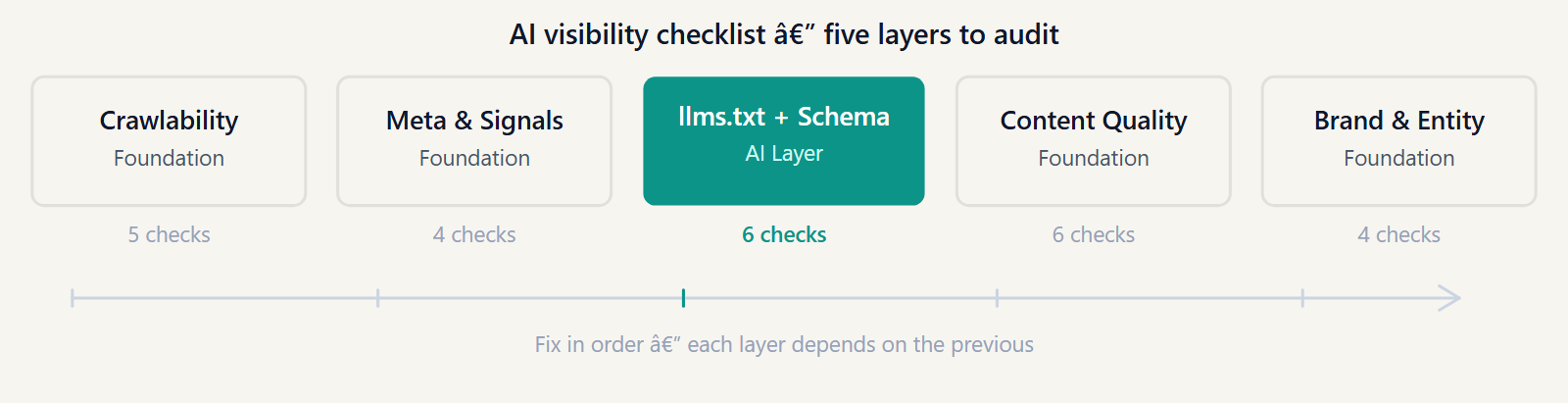
What AI visibility is, and why these eight signals
AI visibility is whether AI answer engines can reach your pages, parse them, and quote them as sources. It is measurable: the GEO score breaks the question into eight categories totaling 100 points, with the open weights below. The weights are not arbitrary — they reflect how much each category influences whether an engine can reach, understand, and quote a page. Access and orientation files carry the most weight because they gate everything downstream.
Work the steps top to bottom. A site that nails content but blocks the crawlers will still score in the foundation band, because the friction sits earlier in the chain. If you want a number to start from, run the free audit and read your current score against each category before you change anything.

Step 1 — Let the AI crawlers you want reach the site
What it is
Your robots.txt file tells automated agents which paths they may fetch. AI engines run their own named user agents, and many sites block them unintentionally — either with a broad Disallow or by a CDN rule that never distinguished AI bots from scrapers.
Why AI engines use it
A retriever that is disallowed simply never fetches the page, so it can never become a source. There are 27 AI bots that GEO Optimizer accounts for across robots.txt. Common citation-related agents include GPTBot and OAI-SearchBot (OpenAI), ClaudeBot and Claude-SearchBot (Anthropic), PerplexityBot (Perplexity), and Googlebot (Google Search and AI Overviews). Google-Extended is a separate, training-only signal for Gemini and doesn't affect citation retrieval.
The concrete fix
Decide deliberately which engines you allow, then state it explicitly rather than relying on a default. Allow the citation-oriented agents you want, keep your sitemap reference in the file, and confirm no upstream CDN rule overrides it. Then re-check that the bots resolve to a clean 200 on your key pages.
Step 2 — Publish an llms.txt map
What it is
An llms.txt file is an emerging convention: a plain-text Markdown file at your domain root that summarizes what your site is about and points AI tools to your most important pages, grouped into sections.
Why AI engines use it
It makes your key URLs explicit instead of leaving an engine to infer them from navigation. A good file has a clear H1, a summary blockquote, sectioned links, and enough depth to cover your real content surface — the same properties the GEO audit scores. It is low-cost and not yet honored by every engine, but it removes ambiguity about which pages matter.
The concrete fix
Create /llms.txt with an H1 title, a one-line summary, and grouped links to your pillar pages, docs, and key guides. The llms.txt generator produces a valid file from your site so you do not have to assemble it by hand.
Step 3 — Add JSON-LD structured data
What it is
Structured data is machine-readable markup — typically JSON-LD using the schema.org vocabulary — that states facts about a page explicitly: Article, FAQPage, Organization, WebSite.
Why AI engines use it
JSON-LD makes entities and relationships unambiguous. Instead of inferring that a string is an author, a date, or an organization, an engine reads it directly. That disambiguation helps both classic rich results and AI systems deciding whether your page is a reliable answer to a question.
The concrete fix
Add Organization and WebSite markup site-wide, then Article on posts and FAQPage where you answer real questions. Keep the structured data consistent with the visible content — do not assert in JSON-LD what the page does not actually say. Both direct @type and @graph arrays are valid.
Step 4 — Keep meta tags clean and unique
What it is
Meta tags describe the page to machines: the <title>, the meta description, the canonical URL, and Open Graph tags.
Why AI engines use it
A unique title and description help an engine identify what a page is about at a glance, and a correct canonical prevents duplicate versions of a page from splitting or confusing that signal. Pages with missing, duplicated, or self-conflicting meta are harder to attribute confidently.
The concrete fix
Give every important page a distinct, descriptive title and description, set a self-referential canonical with a consistent trailing-slash convention, and add Open Graph tags so the page is identifiable when shared or summarized.
Step 5 — Write answer-first, quotable content
What it is
Content structure is how your text is organized: heading hierarchy, where the answer sits relative to the question, and whether facts are stated plainly or buried in prose.
Why AI engines use it
Answer engines lift passages and attribute them. The cleaner and more self-contained a passage is, the easier it is to quote. Research on Generative Engine Optimization is concrete here: adding quotations raised source citation by roughly 41% and adding statistics by roughly 33% (Princeton, arXiv:2311.09735). Concrete, verifiable facts beat vague claims.
The concrete fix

- Lead with a direct answer in the first sentence, then expand.
- Use headings that match the questions people actually ask.
- Prefer concrete numbers, dated statements, and named sources over generalities.
- Add relevant quotations and statistics where they support a claim.
- Break processes into explicit, numbered steps.
- Keep one idea per paragraph so a model can lift a clean passage.
Step 6 — Make your brand a recognizable entity
What it is
Brand and entity signals tie your pages to a single, recognizable organization: consistent naming, clear about and contact pages, knowledge-graph readiness, and sameAs links to your authoritative profiles.
Why AI engines use it
Engines prefer to cite identifiable entities. When your name, schema, and external profiles agree, a model can resolve "who is this" with confidence, which makes attribution safer. Incoherent naming or an orphaned brand makes the same content riskier to quote.
The concrete fix
Use one consistent brand name across the site, publish clear about and contact pages, and add sameAs links from your Organization schema to your verifiable profiles. Keep these aligned with what the pages actually state.
Step 7 — Signal freshness and currency
What it is
Freshness signals tell an engine when content was produced or updated: a declared language, an RSS feed, and explicit, accurate dates.
Why AI engines use it
For time-sensitive questions, engines weigh how current a source is. Undated content, or content whose dates do not match its substance, is harder to trust for anything that changes over time.
The concrete fix
Declare your language in the <html lang> attribute, expose an RSS feed where you publish regularly, and keep datePublished and dateModified accurate in both your visible content and your schema. Update dates only when the content genuinely changes.
Step 8 — Expose AI discovery endpoints
What it is
AI discovery endpoints are machine-readable files that describe your site to AI tooling directly — for example /.well-known/ai.txt and JSON summaries of your site, FAQs, and services.
Why AI engines use it
These endpoints give tooling a structured, low-friction way to read your intent and key facts without parsing every page. They are the smallest category by weight, but they are cheap to add and complete the picture once the higher-leverage steps are in place.
The concrete fix
Publish a /.well-known/ai.txt with your crawler permissions, and serve JSON summaries describing the site, its FAQs, and its services. Keep them in sync with the rest of your signals.
The checklist, in order
Work top to bottom. Each item names the category, the weight it carries out of 100, and the single most important action.
- robots.txt (18): allow the citation-oriented AI bots you want; confirm no CDN rule overrides it.
- llms.txt (18): publish a root-level map with H1, summary, and sectioned links to your key pages.
- Schema JSON-LD (16): add Organization, WebSite, Article, and FAQPage markup that matches the visible content.
- Meta tags (14): give every page a unique title, description, correct canonical, and Open Graph tags.
- Content (12): lead with the answer; add quotations and statistics; one idea per paragraph.
- Brand & entity (10): consistent naming, clear about/contact, and sameAs links from your schema.
- Freshness (6): declare language, expose RSS, keep dates accurate in content and schema.
- AI discovery (6): publish /.well-known/ai.txt and JSON summaries of the site, FAQs, and services.
Read your score, then re-measure
The point of working through the categories is to move a measurable number. Map your audit result to the band it falls into, fix the lowest bands first where the effort is smallest, and re-audit after each round.
Most signals in place; the site is structurally ready to be cited.
Solid foundation with a few high-value gaps left to close.
Core pieces exist but several categories need work.
Crawlability or structure blocks visibility before content matters.
A site in the critical or foundation band should fix crawler access and structure before touching copy — the friction sits earlier in the chain. For the reasoning behind why these eight categories matter for AI engines specifically, see the Generative Engine Optimization guide and the open scoring methodology .

Further reading
- Generative Engine Optimization — the foundational guide to how AI engines retrieve and cite sources.
- llms.txt generator — produce a valid root-level map from your site.
- AI citation checker — see how citable your content is today.
- Scoring methodology — how the eight categories and 100 points are counted.
- Run the free audit — get your baseline score before you start.
Apply this guide
Run an AI SEO audit before you change pages.
Use the audit to find which signal is holding the site back: crawler access, schema, llms.txt, content clarity, AI discovery, or entity strength.
- Best for pages that need a technical and content baseline.
- Next metric: AI readiness score plus the weakest signal category.
Frequently asked questions
What does "AI visibility" actually mean?
AI visibility is the degree to which AI answer engines such as ChatGPT, Perplexity, Claude, and Gemini can reach your pages, parse their content, and quote them as sources. It is distinct from a Google ranking: a page can rank well in classic search and still never surface as a cited source, because answer engines favor pages that are easy to fetch, clearly structured, and safe to quote.
Which of the eight signal categories should I fix first?
Start with crawler access in robots.txt, then llms.txt, because they gate everything downstream. If a bot cannot fetch your page or find your key URLs, the quality of your schema and content never gets a chance to matter. These two categories carry the most weight — 18 points each out of 100 — for exactly that reason.
Does adding llms.txt or schema guarantee I will be cited?
No. These signals improve retrieval and parsing — they make your site easier to find and understand — but citation behavior in AI engines is probabilistic and changes as models are retrained. The signals remove friction; they do not force a citation. Treat them as necessary conditions, not magic switches.
How do quotations and statistics affect AI citations?
Research on Generative Engine Optimization found that adding quotations raised source citation by roughly 41% and adding statistics by roughly 33% (Princeton, arXiv:2311.09735). Concrete, verifiable facts are easier for a model to lift and attribute than vague marketing claims, so front-loading them in your content directly improves quotability.
How do I know whether my changes worked?
Take a baseline audit before you change anything, ship the fixes, then re-audit and compare the score category by category. AI visibility is not a one-time setup: models, crawlers, and citation behavior change over time, so treat it like any other channel — measure, change, re-measure.
Get the monthly State of GEO report
AI search readiness benchmarks, adoption stats, and the actions that move the needle — delivered monthly. No spam.
By submitting, you agree to receive the monthly GeoReady newsletter: benchmark data from the State of GEO dataset, practical GEO guidance, and product updates. You can unsubscribe anytime. See our Privacy Policy.