How GEO Optimizer scores a site — and why the weights are public.
GEO Optimizer · Methodology
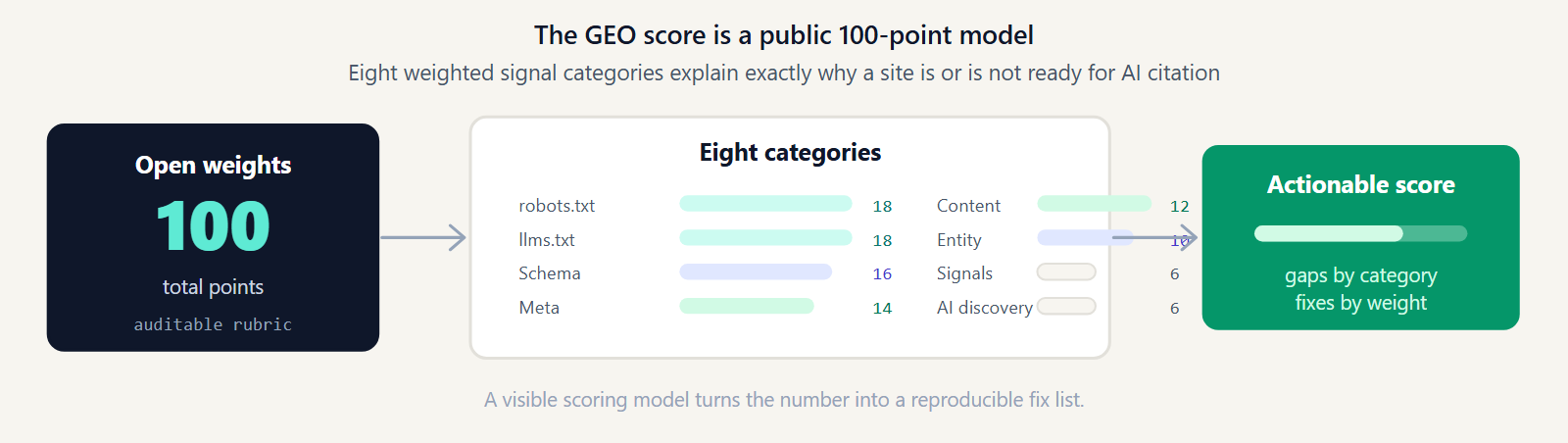
GEO Optimizer scores a site out of 100 across eight signal categories, then adds a research-backed citability layer on top. The weights are not a secret: they are plain constants in an open-source, MIT-licensed repository, so any score can be read, reproduced, and challenged on the record.
Last updated: June 2026
100 points
Distributed across 8 signal categories.
Open weights
Constants in the MIT-licensed repo.
Research-backed
Citability grounded in published papers.
For the science behind the signals, see the research foundation. To turn the score into action, start with the AI visibility checklist.
How the score is built
A GEO audit produces a single number out of 100. That number is the sum of eight category scores, each with a fixed weight. The weights reflect how much a category influences whether an AI answer engine can reach a page, understand what it is about, and quote it confidently. They are deliberately uneven: the categories that gate access and orientation carry more weight than the ones that polish an already-reachable page.
On top of the structural score sits a citability layer — a set of content checks drawn from published research on what makes a passage quotable. The structural score answers “can an engine use this site at all?”; the citability layer answers “once it can, is the content worth lifting?”. Both are visible in the audit output, and both are computed by rules you can read in the source.
The 8 categories and their exact weights
models/config.py · SCORING · Σ = 100 pts
Every site is scored on the same eight categories, weighted to a total of 100 points. robots.txt and llms.txt carry the most weight because they gate everything downstream: if a crawler is blocked or cannot find your key URLs, the quality of the content never gets a chance to matter. Schema and meta tags come next, because they decide whether an engine can resolve the entity and pull facts without guessing.
| Category | Weight | What it measures |
|---|---|---|
| robots.txt robots | 18 | Whether AI crawlers can reach the site and whether the file welcomes citation-oriented bots instead of blocking them by default. It gates everything downstream — an unreachable page never gets scored on anything else. |
| llms.txt llms | 18 | Presence and quality of a root-level llms.txt: a clear H1, a summary, sectioned links, and link depth that point AI systems at the pages worth citing. |
| Schema JSON-LD schema | 16 | Valid structured data — Organization, WebSite, Article, FAQ — that lets engines disambiguate the entity and pull facts with confidence rather than inference. |
| Meta tags meta | 14 | Title, description, canonical, and Open Graph tags that keep the page identifiable and free of duplication when an engine indexes it. |
| Content content | 12 | Heading hierarchy, front-loaded answers, lists, tables, and the numbers and links that make individual passages quotable. |
| Brand & entity brand_entity | 10 | Naming coherence, knowledge-graph readiness, and about/contact clarity that tie a set of pages to a single recognizable entity. |
| Signals signals | 6 | Declared language, RSS, and freshness indicators that help an engine judge how current and maintained the source is. |
| AI discovery ai_discovery | 6 | Machine-readable endpoints such as /.well-known/ai.txt and JSON summaries that expose the site to AI tooling directly. |
| Total | 100 | The sum of all eight category weights. |
The same weights apply to every site, so two audits are always directly comparable. A site can score well on content yet lose most of its points to a single blocked crawler — which is exactly the kind of imbalance the category breakdown is meant to expose.
How to read the score bands
models/config.py · SCORE_BANDS
The total score falls into one of four bands. The band is a summary, not a verdict: it tells you roughly how much structural work remains, but the category breakdown is where the actual to-do list lives.
| Range | Band | What it means |
|---|---|---|
| 86–100 | Excellent | Most signals are in place; the site is structurally ready to be cited. |
| 68–85 | Good | A solid foundation with a few high-value gaps left to close. |
| 36–67 | Foundation | Core pieces exist, but several categories still need work. |
| 0–35 | Critical | Crawlability or structure blocks visibility before content quality matters. |
Prioritize by where the gap is largest and the effort is lowest. A site in the foundation band almost always has more to gain from fixing crawlability and structure than from rewriting copy — the points are concentrated in the categories that gate everything else.
The citability layer: 47 research-backed checks
arXiv:2311.09735 · KDD 2024
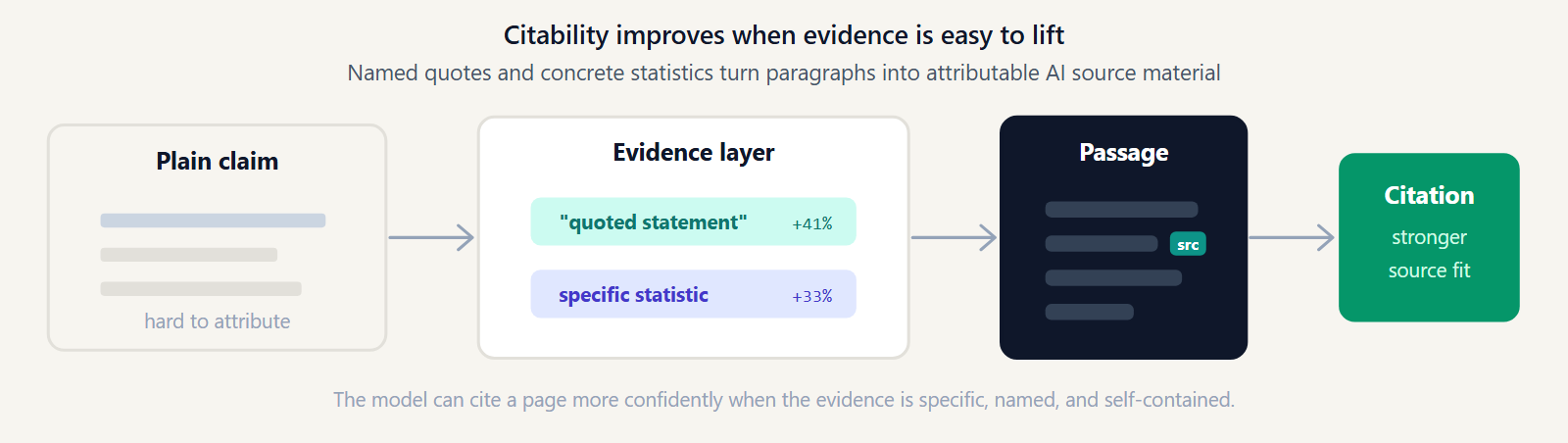
Beyond the structural score, GEO Optimizer runs 47 content checks that estimate how quotable a page is. These checks are not opinions; they map directly to findings in published research on generative engine optimization. The two strongest signals are direct quotations and concrete statistics — both measured to raise citation rates in the Princeton study.
| Signal | Citation lift | Why it works |
|---|---|---|
| Quotations | +41% | Direct quotes from named sources give an engine a self-contained, attributable passage it can lift verbatim. |
| Statistics | +33% | Concrete numbers anchor a claim and are easier for a model to surface than a general assertion. |
The lift figures come from Princeton’s KDD 2024 paper (arXiv:2311.09735), the first systematic study of which on-page changes move AI citations. AutoGEO (ICLR 2026, arXiv:2510.11438) builds on it and reports a +50.99% improvement over the Princeton baseline by optimizing content automatically. The full list of sources behind every signal is on the research page.
Why we publish the weights
A visibility score is only useful if you can interrogate it. Publishing the weights as open-source constants does three things. It makes the score reproducible — you can run the same audit locally and get the same number. It makes the score auditable — you can read the exact rule behind any category and disagree with it specifically. And it makes the score honest — there is no hidden lever to inflate a result or favor a particular kind of site.
The weights and every check live in the open-source repository under the MIT license. If you think a category is weighted wrong for your context, you can read the code, open an issue, or fork it and re-weight it yourself. That is the point of publishing them: a methodology you can change on the record is more trustworthy than one you have to take on faith.
Score stability, measured
"Reproducible" is a claim you can check, not a description we'll ask you to trust. We measured it against real usage of the hosted audit rather than a synthetic test: every pair of audits of the same domain, run back to back (48 hours apart or less, so it isolates measurement noise from the site actually changing), across every domain audited on GeoReady.
Audit pairs ≤48h apart · measured 2026-08-30
exit 0| Metric | Value |
|---|---|
| Audit pairs measured | 2,513 (216 distinct domains) |
| Pairs with zero score movement | 98.6% |
| Average score movement | 0.09 points |
| Pairs within 3 points of each other | 99.4% |
Measured 2026-08-30. When two consecutive audits of the same site do disagree by more than a few points, it is almost always because something on the site changed between them, not because the scoring is noisy — this is what the published, fixed weights buy you: a number that moves for a reason you can find, not one that drifts on its own. We'll re-run this measurement periodically rather than let a good number go stale on the page.
Want to check these numbers rather than read about them? See what you can verify yourself — the constants, the test suite, and the one command that reproduces any score.
Methodology FAQ
What is an AI visibility score?
An AI visibility score is a number — in GEO Optimizer, a score out of 100 — that measures how well a site is structured for AI answer engines to crawl, understand, and evaluate. It differs from a traditional SEO score: rather than evaluating keyword density or backlinks, it checks signals like AI crawler access, llms.txt, schema JSON-LD, content quotability, and entity clarity. The score answers the readiness question — can an AI engine use this site? — not the outcome question of whether you are currently cited.
Why are the scoring weights public?
GEO Optimizer is open source under the MIT license, and the weights live in the repository as plain constants. Publishing them means anyone can read exactly how a score is produced, reproduce it locally, and disagree with a specific number on the record rather than against a black box. A visibility score you cannot inspect is a score you cannot trust.
How are the 100 points distributed?
Across eight categories: robots.txt 18, llms.txt 18, schema 16, meta tags 14, content 12, brand and entity signals 10, freshness signals 6, and AI discovery 6. Crawlability and orientation files carry the most weight because they gate everything else — if a bot cannot fetch the page or find your key URLs, content quality never gets a chance to count.
Does a higher GEO score guarantee more AI citations?
No. The score measures structural readiness — whether crawlers can reach the site, whether content is quotable, and whether the entity is clear. Citation behavior in AI engines is probabilistic and shifts as models are retrained. A stronger score removes friction; it does not force a citation.
Where does the citability layer come from?
It is a set of 47 content checks derived from published research. The headline signals — direct quotations and concrete statistics — carry measured citation lift in the Princeton KDD 2024 study (arXiv:2311.09735), and AutoGEO (ICLR 2026, arXiv:2510.11438) reports a +50.99% improvement over that baseline. The checks turn those findings into auditable rules.
Can I change the weights for my own use?
Yes. The scoring weights are constants in the open-source repository, so you can fork it and re-weight the categories for your context. The defaults reflect how much each category influences whether an AI answer engine can reach, understand, and quote a page, but they are a starting point, not a fixed law.