The book on getting cited by AI search.
Free 160-page technical manual
ChatGPT, Perplexity, and Google AI Overviews choose 3–7 sources before a user ever sees a link. This manual is the technical reference for being one of them — built from audit data across 1000+ sites, not theory.
160
pages
15
chapters
5
appendices
11
AI crawlers documented
Not sure yet? Read a free 3-chapter preview — Chapter 0 (The Selection Layer), Chapter 4 (Access), and Chapter 7 (Quotability). No email required.
Download free preview (PDF, 27 pages)No spam. By downloading, you agree to our Privacy Policy.
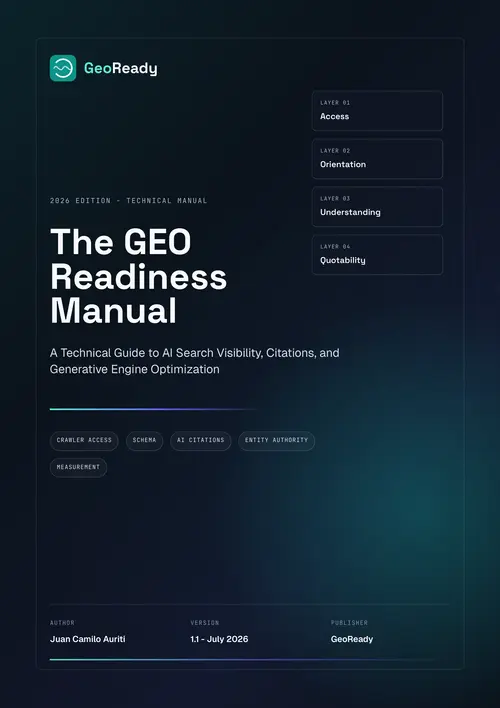
Get the PDF in your inbox
Enter your email. We'll send a download link valid for 24 hours — no account, no credit card.
Crawler access
11 AI crawlers documented
Schema deep dive
12 types with JSON-LD templates
Entity authority
Pillar-cluster architecture
Measurement
Citation tracking workflow
AI search doesn't rank you. It selects you.
Traditional search returns ten links and asks the user to choose. AI answer engines choose first — synthesizing a single answer from 3-7 sources — then show the user the result. If your site isn't one of those sources, you're not on page two. You're absent from the answer entirely.
The user reads one answer. They may never see the sources that weren't selected.
This is not a traffic problem. It's a selection problem. And the rules of selection are different from the rules of ranking. Keywords don't work the same way. Backlinks don't work the same way. Meta descriptions don't work the same way. The infrastructure that got you to page one on Google may be invisible to ChatGPT.
This manual is the technical guide to being selected.
The four-layer model
Everything in the manual reduces to four layers, applied in order — plus entity authority as a multiplier. Fix access before orientation. Fix orientation before schema. Fix schema before quotability. Build entity authority alongside all of them. Measure at the end, not the beginning.
- 01 Access
Crawl permissions, status codes, rendering, canonical control
- 02 Orientation
llms.txt, sitemap, feeds, priority URLs, discovery hints
- 03 Understanding
Schema, entity identity, metadata, page-type clarity
- 04 Quotability
Self-contained passages, factual density, source-worthy claims
- 05 Entity Authority
Independent mentions, consistent profiles, topical footprint
- 06 Measurement
Prompt sets, citations, competitors, logs, iteration backlog
Inside the manual
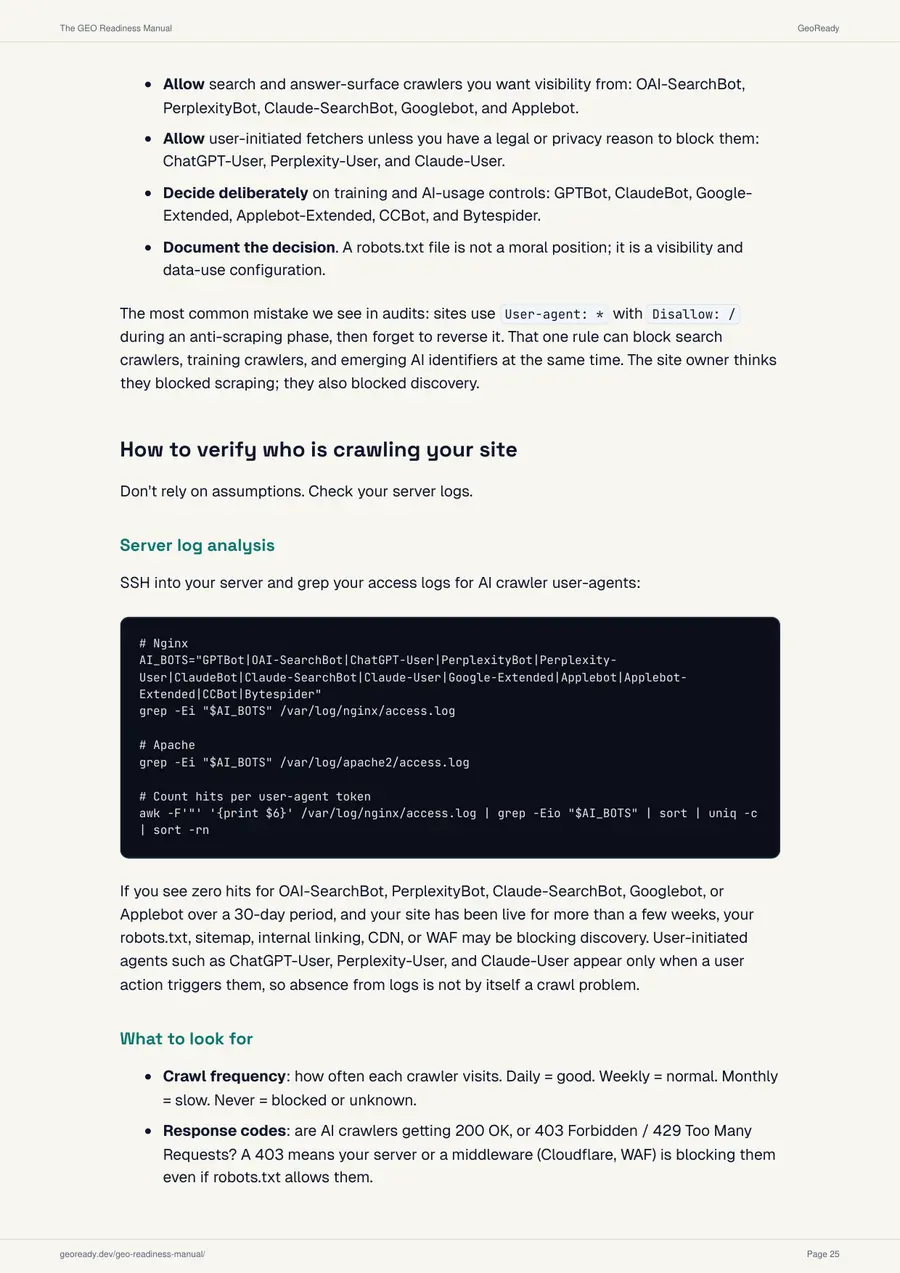
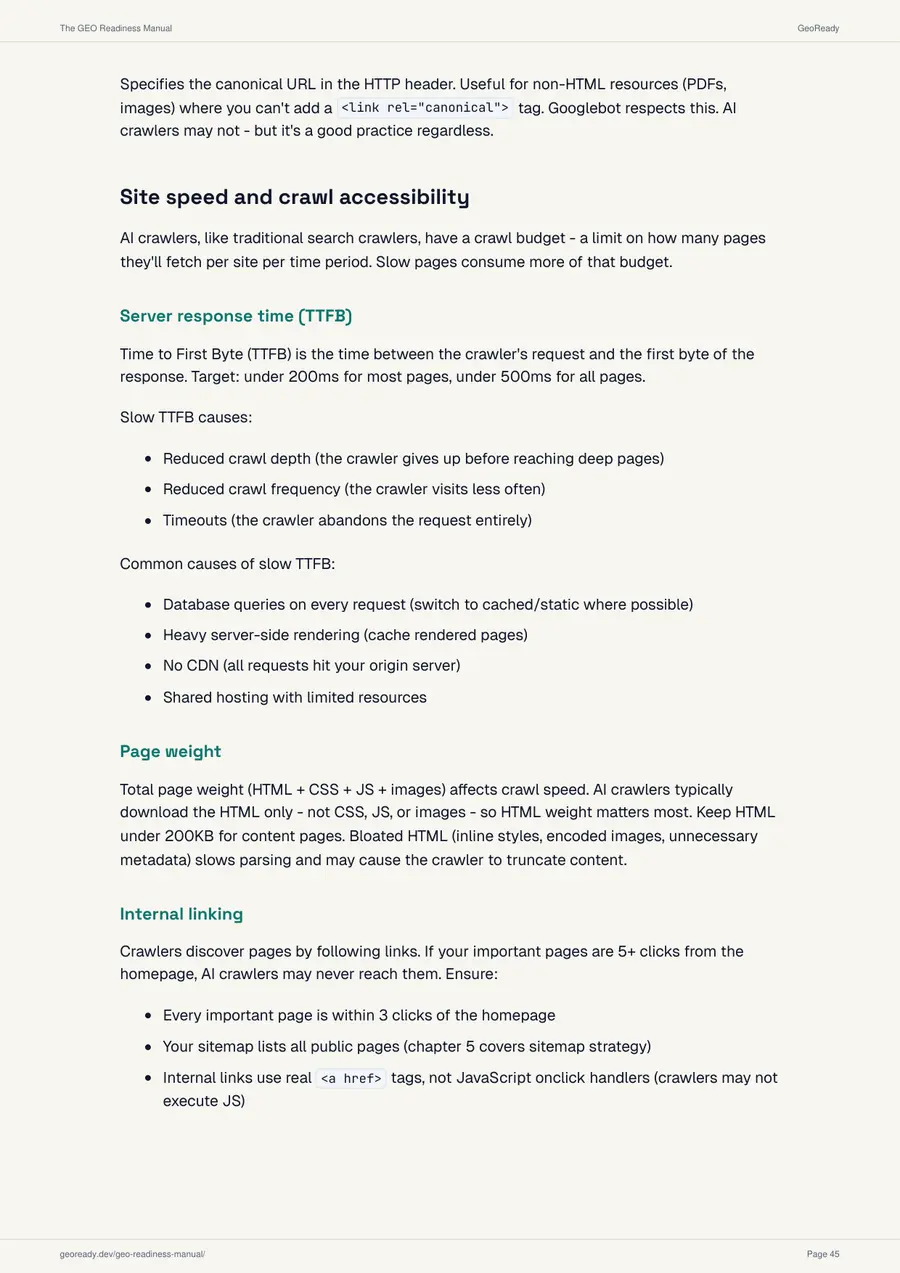
Two real spreads — server log commands for verifying AI crawler access, and the site-speed factors that shrink your crawl budget.
What's inside
The 4-layer GEO model
Access, Orientation, Understanding, Quotability — applied in order. Fix access before schema. Fix schema before content. The order matters.
11 AI crawlers documented
GPTBot, OAI-SearchBot, PerplexityBot, ClaudeBot, Claude-SearchBot, Googlebot, Google-Extended, Applebot, CCBot, Bytespider, Diffbot — with user-agent tokens, robots.txt directives, and GEO implications.
12 schema types with templates
Article, FAQPage, HowTo, Organization, Person, Product, VideoObject, ImageObject, BreadcrumbList, WebSite, DefinedTerm, Dataset — with copy-paste JSON-LD templates and @graph examples.
Passage extraction mechanics
How vector embeddings select passages, why BLUF (Bottom Line Up Front) beats narrative, and 5 anti-patterns that make your content invisible to retrieval.
Entity authority strategy
Pillar-cluster architecture, sameAs cross-platform identity, entity resolution pipeline, independent mentions — why 5 connected pages beat 1 perfect page.
Citation measurement workflow
Manual prompt testing protocol, GA4 attribution, server log analysis, GEO metrics (citation presence, rate, share, accuracy, drift) — weekly, monthly, quarterly cadence.
Prompt injection defense
8 attack vectors against AI crawlers, CSP configuration, monitoring scripts, and a response plan for when your citations disappear.
Vertical-specific guidance
SaaS/B2B, e-commerce, editorial, WordPress, and headless CMS — with platform-specific implementation patterns and pitfalls.
Who this is for
SEO practitioners
Who need to extend their skill set to cover AI answer engines — not replace their SEO knowledge, but add a new layer on top.
SaaS and B2B teams
Whose buyers ask ChatGPT "what's the best tool for X" before visiting any vendor website. If you're not in that answer, you're not in the consideration set.
Developers and tech leads
Responsible for the infrastructure that makes content accessible to AI crawlers. robots.txt, rendering, schema, server responses — the technical foundation.
Marketing leaders
Who need to decide where to invest between classic SEO and GEO in 2026 — with honest evidence about what works and what doesn't.
Table of contents
Appendices
FAQ
Is this a marketing ebook?
No. It's a 160-page technical manual with code examples, JSON-LD templates, server log commands, robots.txt configurations, and audit checklists. It's written for practitioners, not for list-building.
Does it replace the free guides on geoready.dev?
No. The guides cover specific topics. The manual is the comprehensive reference that connects them — including material not on the site: the AI engine pipeline, passage extraction mechanics, prompt injection defense, and the GEO maturity model.
Is the content based on real data?
Yes. The manual draws from 1000+ site audits, the GeoReady benchmark dashboard, public State of GEO reports, official crawler documentation, and reasonable inference from how RAG systems work mechanically. Every claim is labeled by evidence level.
What format is the PDF?
A4 format, 160 pages, with a cover page, table of contents, diagrams, code blocks, tables, and appendices. It's a readable document, not a slide deck or a series of blog posts stitched together.
Why do you need my email?
We use your email to send a signed download link for the full PDF. The link is valid for 24 hours. GEO research updates are optional: check the consent box if you want them, leave it unchecked if you only want this one download email.
Can I share it with my team?
Yes. Once you download the PDF, share it internally. If you want to share it publicly (blog post, social media, newsletter), link back to this page so others can get their own copy.
Get the manual, free.
160 pages, delivered to your inbox in under a minute. Then run a free audit to see exactly where your own site stands.
Prefer to read first? Download a free 3-chapter preview — no email required.
Get the free preview (PDF, 27 pages)