AI Citation Checker: is your brand cited by AI answer engines?
Powered by Perplexity Sonar — real, verifiable source citations
When your customers ask an AI engine "what's the best tool for…", does the answer mention your brand and cite your domain — or a competitor's? This tool asks a real AI answer engine and shows you the verdict, with the actual sources the AI cited. Citation patterns correlate across engines: content that Perplexity cites is building the signals other AI engines reward.
Ask
Customer-style category prompts.
Trace
Returned sources and cited domains.
Act
Verdicts that point to the next fix.
When customers ask AI about your category, these domains get cited — and you don’t.
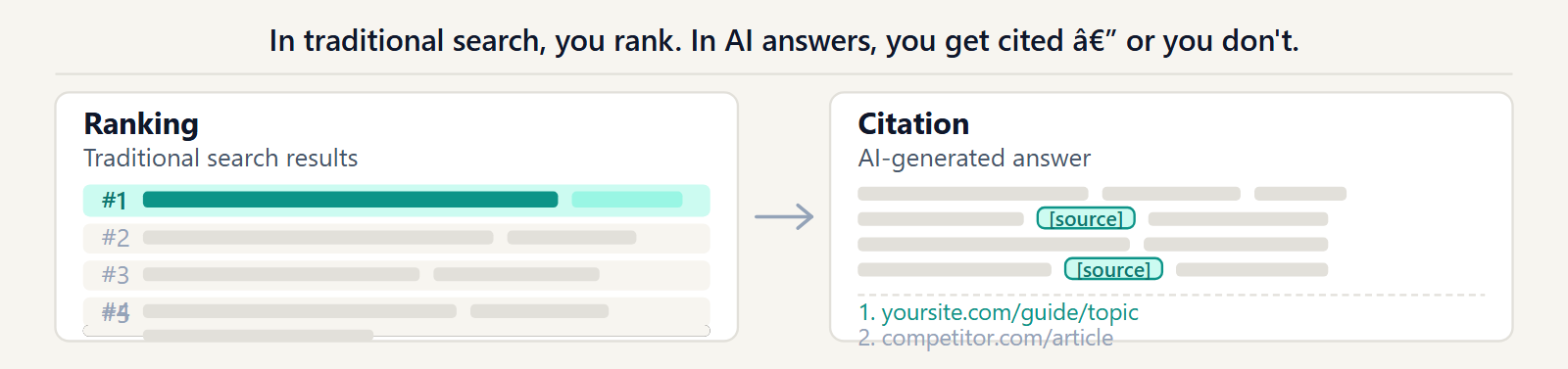
Citation checks and visibility checks answer different questions.
Choose the right check
This check is a one-off, Perplexity-only snapshot — need recurring tracking instead? If you are weighing paid trackers, the RankScale alternative page compares one of them with GeoReady. And if a competitor keeps showing up in the sources instead of you, the citation gap analysis workflow covers the wider diagnosis.
Run a citation check
Test a brand, domain, and category against source-backed AI answers.
Tool workspace
POST /api/citations
Why AI citations matter more than rankings
AI answer engines don't show ten blue links — they give one answer and cite a handful of sources. If your domain is among those sources, you capture the click and the trust. If it isn't, the AI is actively sending your customers to whoever is cited. AI answers and classic Google rankings don't always overlap: a page can rank well on Google and never be cited by AI, so citation is a different game from classic SEO, with different winners.
What the four verdicts mean
Strong — your domain is cited as a source in most answers. Monitor it: positions degrade silently.
Cited — you appear among sources, but not consistently. Strengthen citability to win more answers.
Mentioned only — the AI knows your brand from third parties but never cites your own pages. Make your domain the reference.
Invisible — neither mentioned nor cited. Start with a free GEO audit and fix the high-impact items first.
How to improve your AI citations
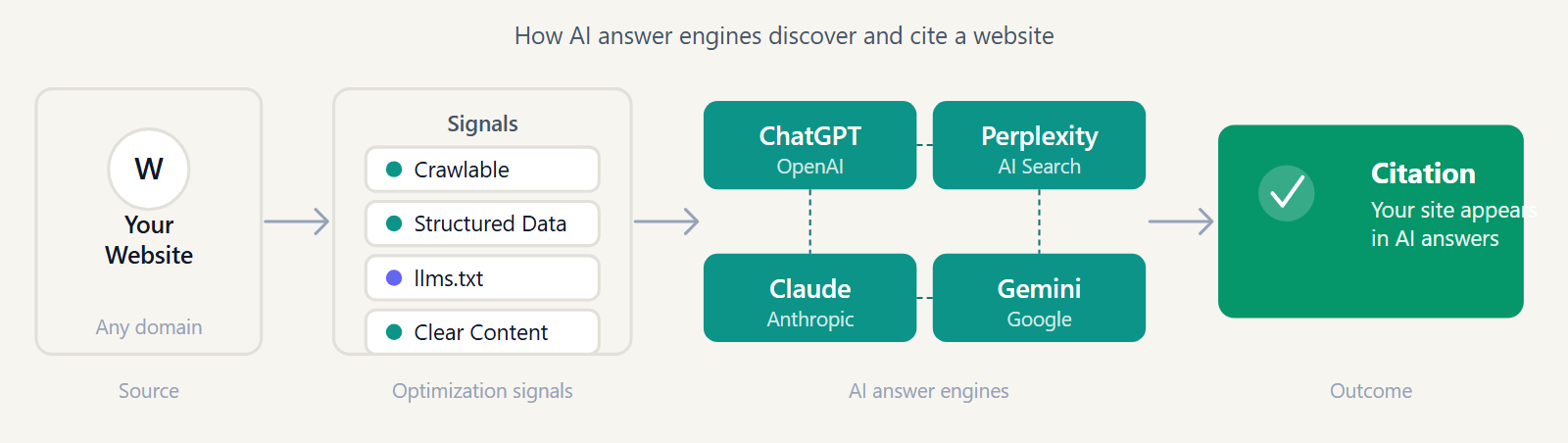
If the term is new, start with what are AI citations. Citations are earned with technical and content signals that AI retrieval rewards: open access for AI crawlers, structured data, an llms.txt, quotable statistics, and multi-page topical coverage. The GEO guide covers the full playbook, and the free GEO audit scores your site on 100 points across nine categories. For the background method behind this tool, see the step-by-step guide that answers how do I know if my content is cited in ChatGPT answers? Run the audit, fix the priority items, then come back and re-check your citations.
Which AI citation result should trigger action?
A single AI citation check is useful only if it leads to the right next step. Use the result below to decide whether to monitor, improve the source page, or rebuild the visibility foundation.
| Result | Risk | Next action | GeoReady workflow |
|---|---|---|---|
| Strong | You can lose citations without noticing. | Track the same prompts weekly. | Agency citation snapshots and alerts. |
| Cited | Competitors still appear in adjacent prompts. | Find the prompts where your domain is missing. | Prompt tracking plus competitor comparison. |
| Mentioned only | Third-party pages define your brand for AI answers. | Make your own domain the better source. | Audit, source gaps, structured content fixes. |
| Invisible | AI answers send buyers to other domains. | Fix crawlability, schema, content, and authority first. | Free GEO audit, then monitored fixes. |
Frequently asked questions
What does an AI citation checker do?
An AI citation checker asks an AI answer engine the questions your customers ask and reports whether your brand is mentioned and whether your own domain is cited as a source. It tells you, for a given category, whether AI answers point people to you or to someone else.
How is this different from rank tracking?
Rank trackers measure your position in a list of ten blue links on Google. An AI citation checker measures something different: whether an AI answer cites your domain as one of the few sources behind a single generated answer. A page can rank well on Google and still never be cited by AI, so the two metrics do not move together.
Which AI engines does it check — ChatGPT or Perplexity?
The check queries Perplexity Sonar, an answer engine grounded in live web search that returns the exact source URLs it cited, which makes citations verifiable. ChatGPT and other parametric models do not expose their sources the same way. Citation patterns correlate across engines: content that is citable for Perplexity is building the signals other AI engines reward.
How does the AI citation checker work?
It sends customer-style questions about your product category to Perplexity Sonar, an AI answer engine grounded in live web search, and analyzes the answers: is your brand mentioned in the text, and does your domain appear among the cited sources? You also see which competitor domains were cited instead of you.
What does "mentioned but not cited" mean?
The AI knows your brand — usually from third-party pages like reviews or directories — but never cites your own domain as a source. That means other sites are the reference for your own product. The fix is making your own pages the citable source: structured data, llms.txt, statistics, and quotable content.
How often do AI citations change?
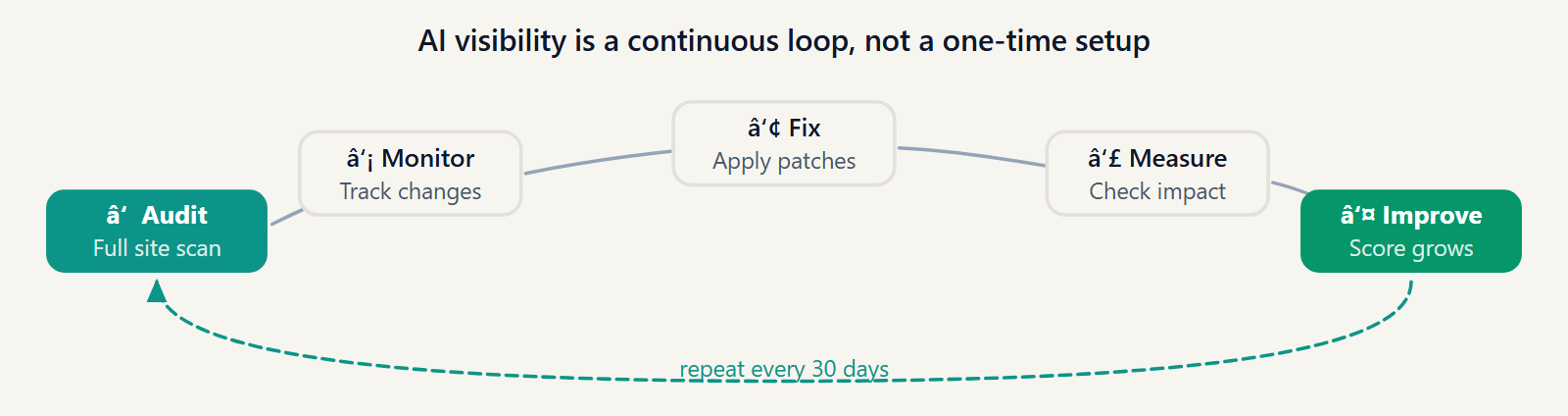
Continuously. AI answers are regenerated for every query and the underlying indexes refresh constantly, so a brand cited today can silently disappear next week. A one-shot check is a snapshot; ongoing monitoring is how you catch losses early.
Is this check really free?
Yes. Each check asks the AI engine two questions at our expense, so there is a fair-use limit per visitor and per day. Pro ($19/month) adds domain monitoring, score history, and regression alerts. Scheduled AI citation tracking — running these checks automatically and alerting you on wins or losses — is on Agency ($89/month founding, then $199/month).
One check is a snapshot. Tracking is the moat.
AI answers change every week. GeoReady turns this one-off check into ongoing AI citation tracking: it runs your citation checks on a schedule, alerts you when you lose or win a citation, and shows who replaced you — so you act before the traffic moves.