How do I know if my content is cited in ChatGPT answers?
How to know if your content is cited in ChatGPT or Perplexity answers: a 10-minute manual check, a free automated check, and ongoing monitoring.
There are three ways to tell if ChatGPT and Perplexity cite your brand:
- A manual check — ask the engines yourself, in about 10 minutes.
- A free automated check — one tool run, one verdict.
- Ongoing monitoring — scheduled checks with alerts, for when the answer changes.
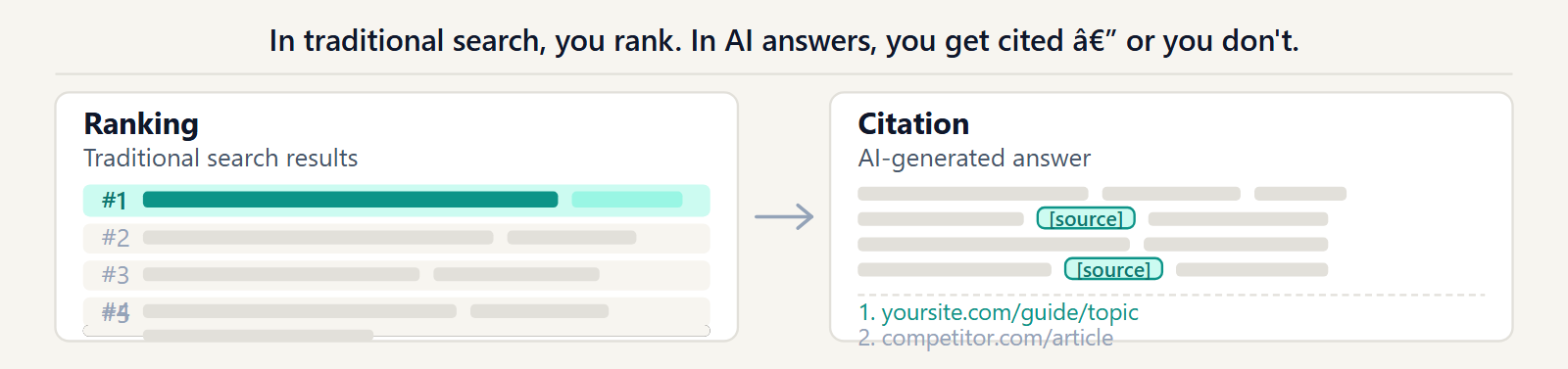
In classic search you rank. In AI answers, your domain is cited as a source or it is absent.
Citations are the new rank
AI answer engines don't show ten blue links. They synthesize one answer and attribute it to a handful of sources. Being one of those sources is the closest thing to "position 1" that exists in this interface — and it follows different rules than Google rankings. Ahrefs found that 28.3% of ChatGPT's most-cited pages have zero organic visibility on Google. Different game, different winners.
The check itself splits into two distinct questions, and conflating them hides the most actionable diagnosis:
- Mention — does the answer text name your brand?
- Citation — does your domain appear among the answer's sources?
Mention vs. citation: only a citation sends the AI's trust — and the click — to your domain instead of a third party.
Method 1: ask the engines yourself
The manual method costs nothing and teaches you a lot. Open a fresh session (no account personalization), and ask the questions a buyer would ask: "best [category] for [audience]", "how do I solve [problem]", "[your brand] vs [competitor]". Note three things: is your brand named, which domains are cited, and who is recommended first.
Its limits are real, though. Answers are non-deterministic — the same question can produce different sources an hour later. ChatGPT without browsing doesn't expose sources at all, so you can verify mentions but not citations. And manual checks don't scale past a handful of queries, which is exactly why snapshots and history matter more than any single answer.
Method 2: the free automated check
The free AI citation checker automates the manual method against Perplexity Sonar — an engine that grounds every answer in a live web search and returns the exact URLs it cited, which makes citations verifiable rather than guessed. You enter brand, domain, and what you sell; it asks customer-style questions and returns one of four verdicts:
- 🏆 Strong — cited as a source in most answers. Your job shifts to defense: monitor for silent regressions.
- ✅ Cited — present but inconsistent. Strengthen citability where you already have traction.
- 🟡 Mentioned only — the AI knows you from third-party pages; reviews and directories get your citation. Make your own pages the reference.
- ❌ Invisible — neither mentioned nor cited. Foundation work first: run the free GEO audit and fix the high-impact items.
The most valuable output is often the "cited instead of you" list: the domains the AI actually trusts for your category. That list is your real competitive set in AI search — frequently different from your Google competitors.
The AI Citation Checker's four verdicts, from strongest to weakest: Strong, Cited, Mentioned only, Invisible.
What to do with each verdict
Citations are earned with citability signals, and the fix depends on the diagnosis. If you're invisible, start with access and structure: AI crawlers allowed in robots.txt, valid JSON-LD, an llms.txt, real content depth. If you're mentioned only, the problem is that third parties are more citable than you: publish the statistics, comparisons, and quotable definitions about your product that reviewers currently provide. If you're cited but inconsistent, build multi-page topical authority so the engines see an entity, not a page.
The full playbook lives in our GEO guide and the AI visibility checklist.
Method 3: monitoring — because answers change weekly
Every check above is a snapshot. AI indexes refresh continuously, models update, competitors publish — a brand cited today can disappear from answers next week without any signal on your side. Treating citation checking as a recurring measurement, with history and alerts, is what turns it from curiosity into a channel you manage.
GeoReady runs scheduled checks, archives the answers as evidence, and alerts you when you lose (or win) a citation: this is automated citation tracking (Agency) — up to 50 automated Perplexity checks a day, with score history and alerts.
A citation check is a snapshot. Monitoring with alerts is what catches a lost citation before the traffic disappears.
Further reading
- Entity-based authority: why five pages beat one strong page — the structural lever behind consistent citations.
- How to appear in ChatGPT and Perplexity sources — the technical checklist.
- Multimodal GEO — making images and video citable too.
- 5 signs AI isn't citing your website
- How long until ChatGPT cites a new page?
- Free tools to check AI search visibility
- GEO for Agencies: Auditing and Reporting AI Visibility for Clients
Apply this guide
Check whether Perplexity-style answers cite your domain.
Use the citation checker path when the risk is that answer engines quote competitors, review sites, or third-party sources instead of your own pages.
Check Perplexity citations · Audit citation readiness
- Best for source-backed answers where the cited URL matters.
- Next metric: direct citations, competitor citations, and missing citations.
Apply this guide
Check whether Perplexity-style answers cite your domain.
Use the citation checker path when the risk is that answer engines quote competitors, review sites, or third-party sources instead of your own pages.
- Best for source-backed answers where the cited URL matters.
- Next metric: direct citations, competitor citations, and missing citations.
Frequently asked questions
How do I know if ChatGPT recommends my brand?
Ask it the questions your customers ask — "what is the best X for Y" — in a fresh session without personalization, and note whether your brand appears in the answer. Repeat across phrasings and days: answers are regenerated every time, so a single response proves little. For source citations specifically, engines grounded in web search like Perplexity are easier to verify because they list the URLs they cited.
What is the difference between being mentioned and being cited?
A mention means the model names your brand in the answer text; a citation means your domain appears among the sources the answer is grounded in. Mentioned-but-not-cited is the most common in-between state: the AI learned about you from third-party pages — reviews, directories, comparisons — and those pages, not yours, get the citation and the click.
How often should I check my AI citations?
Weekly is a sensible floor for a category you care about. AI answers change continuously as indexes refresh and models update, and citation positions degrade silently — you only notice when the traffic is already gone. That is why one-shot checks are diagnostics, and monitoring is the actual discipline.
Can I force an AI engine to cite me?
No. There is no submission form and no paid placement for organic AI citations. What you control is citability: open crawler access, structured data, an llms.txt, quotable statistics with sources, and multi-page topical coverage. Research (Princeton KDD 2024) measured which content patterns increase citation probability — statistics, quotations, and cited sources lead. Get the monthly State of GEO report — AI search readiness benchmarks, adoption stats, and the actions that move the needle — delivered monthly. No spam. [Notify me] By submitting, you agree to receive the monthly GeoReady newsletter: benchmark data from the State of GEO dataset, practical GEO guidance, and product updates. You can unsubscribe anytime. See our Privacy Policy.
Get the monthly State of GEO report
AI search readiness benchmarks, adoption stats, and the actions that move the needle — delivered monthly. No spam.
By submitting, you agree to receive the monthly GeoReady newsletter: benchmark data from the State of GEO dataset, practical GEO guidance, and product updates. You can unsubscribe anytime. See our Privacy Policy.