Entity-based authority: why five pages beat one strong page
AI engines map entities and topic coverage, not keywords. How clusters, pillars, and internal links build citation-worthy authority. Audit free.
From keywords to entities
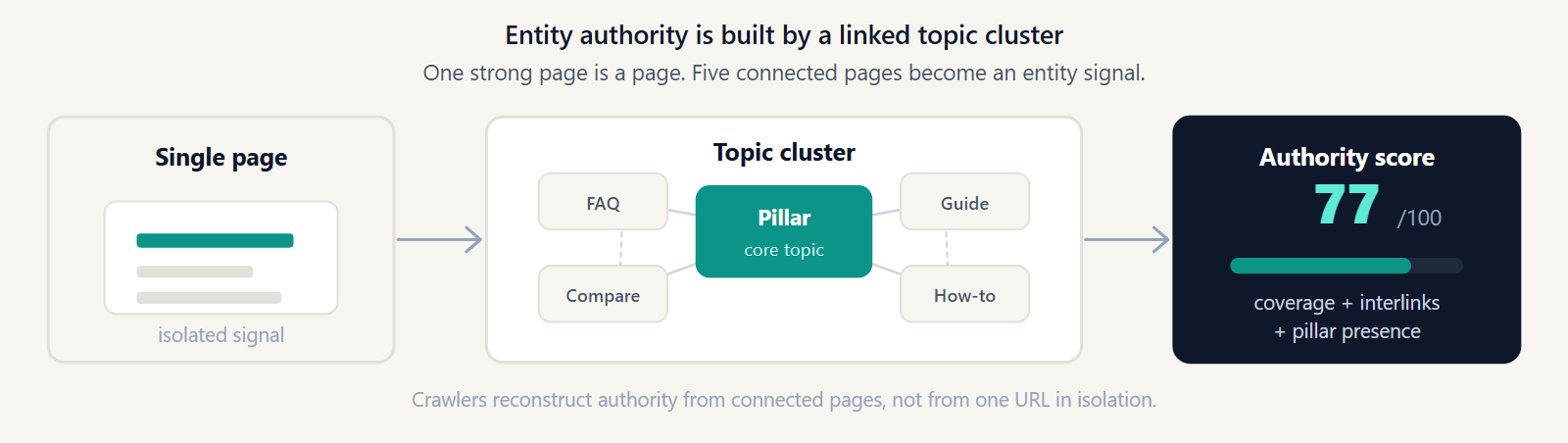
Classic SEO taught us to think in keywords: one query, one target page. Retrieval-augmented engines work differently. When a model answers "what's the best approach to X", it retrieves passages from many documents, weighs how consistently each source covers the topic, and attributes the synthesis to the sources it trusts. Trust here is a property of the entity — the brand, the domain, the author — not of a single URL.
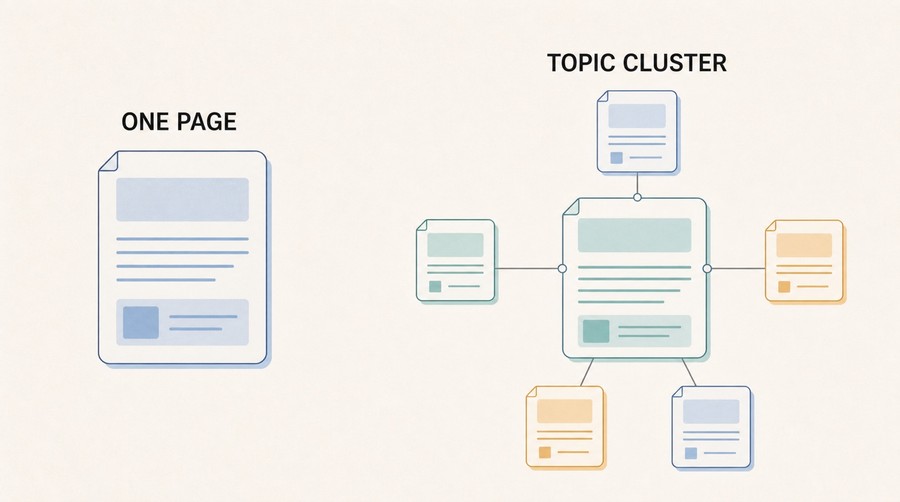
That is why thin-but-broad sites and single-hero-page sites both underperform in AI answers. The pattern that wins is the topic cluster: several pages covering one subject from different angles, clearly tied together, with one page that states the topic explicitly.
The anatomy of a citable cluster
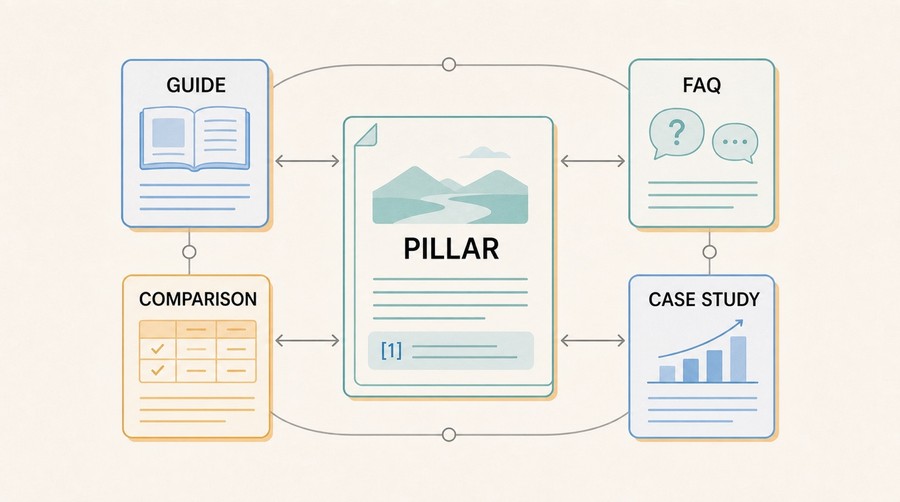
- A pillar page — title and H1 state the topic in plain words ("Generative Engine Optimization: a practical guide"). This is the page engines can anchor the entity to.
- Supporting pages — guides, FAQs, comparisons, case studies that each answer one adjacent question. Aim for depth, not volume: 4-6 genuinely useful pages outperform 20 shallow ones.
- Hub-and-spoke internal links — every supporting page links to the pillar and to at least one sibling. Crawlers reconstruct your site as a graph; orphan pages on the same topic read as unrelated documents, and the cluster effect disappears.
- Consistent terminology — call the topic the same thing everywhere. Synonym drift across pages ("AI SEO" here, "GEO" there, "answer engine optimization" elsewhere) splits the entity into weaker fragments.
Measure it: the topic authority audit
The open-source GEO Optimizer CLI ships an authority analysis that reads your sitemap, clusters pages by shared key terms (filtering out navigation boilerplate), and scores depth, interlinking, and pillar presence out of 100:
The example above is our own site. We followed the tool's advice — this article is one of the supporting pages it told us to write. Eating your own dog food is the fastest way to trust a metric.
Building a cluster in practice
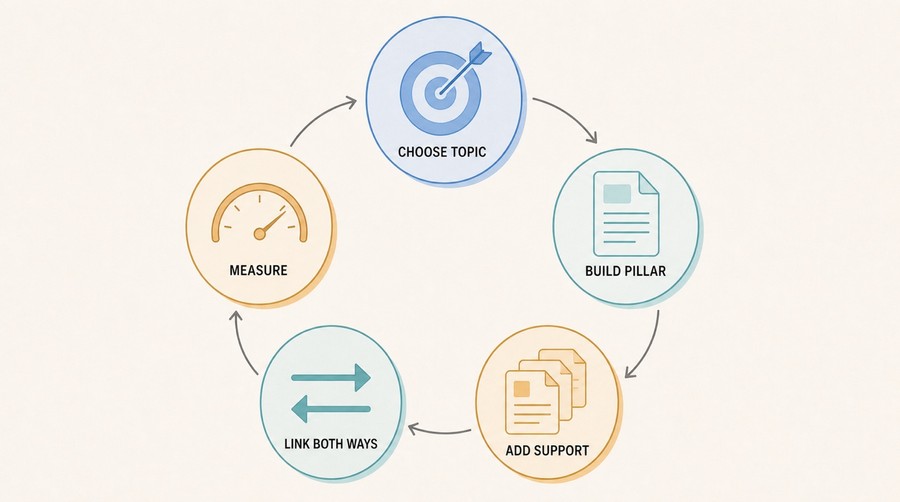
- Pick the one topic you must own. The category your buyers describe their problem with — not your product name (your brand is identity, not a topic).
- Write or upgrade the pillar. Title states the topic; the page defines it, answers the core question in the first 30%, and links to every supporting page.
- Add supporting pages one question at a time. Each page should be the best answer to one query a buyer actually asks. Statistics, examples, and quotable definitions raise citability (Princeton KDD 2024 measured +27-41% for cited sources and quotations).
- Wire the links both ways. Pillar → supports, supports → pillar, supports → siblings where relevant. Use descriptive anchor text, not "read more".
- Re-measure monthly. Clusters decay: pages get orphaned in redesigns, terminology drifts, competitors out-cover you.
Common mistakes that fake authority
- Navigation terms mistaken for topics. Menu labels appear on every page; that's boilerplate, not coverage. (The audit filters terms present on more than 80% of pages for exactly this reason.)
- Brand-stuffing. Repeating your brand everywhere builds identity, not topical authority — engines need to see the subject covered.
- Publishing volume without angles. Five near-duplicate posts are one page in the entity graph. Each supporting page must add a distinct angle.
- Clusters without a pillar. Coverage without a page that names the topic leaves engines nothing to anchor to.
Authority is the input. Citations are the output.
Topic clusters are means, not ends: the end is being the source AI answers attribute. Close the loop by measuring both sides — run the free AI citation check to see whether engines cite you today, build the cluster, then re-check. GeoReady tracks both over time: your audit score and your citations, with alerts when either regresses.
Further reading
- How to check if AI engines cite your brand — measure the output side.
- AI visibility checklist — every signal, with pass/fail criteria.
- GEO vs SEO — why the keyword playbook doesn't transfer.
- Do backlinks still matter for AI search?
- Organization & sameAs schema for LLMs
Apply this guide
Run an AI SEO audit before you change pages.
Use the audit to find which signal is holding the site back: crawler access, schema, llms.txt, content clarity, AI discovery, or entity strength.
- Best for pages that need a technical and content baseline.
- Next metric: AI readiness score plus the weakest signal category.
Frequently asked questions
What is a topic cluster, and why does it matter for AI citations?
A topic cluster is several pages covering one subject from different angles, linked in both directions and anchored to one pillar page that states the topic explicitly. AI answer engines trust entities, not single URLs — a cluster gives repeated, corroborating evidence about the topic that one strong page alone can't.
How many supporting pages does a citable cluster need?
Aim for depth, not volume — 4 to 6 genuinely useful supporting pages (guides, FAQs, comparisons, case studies) outperform 20 shallow ones. Each page should be the best answer to one question a buyer actually asks.
What's the difference between topical authority and brand-stuffing?
Repeating a brand name across pages builds identity, not topical authority. AI engines need to see the subject itself covered from multiple angles — brand mentions alone don't demonstrate coverage of the topic.
How do you measure whether a site has real topical authority?
The open-source GEO Optimizer CLI includes a topic authority audit that reads your sitemap, clusters pages by shared key terms (filtering out navigation boilerplate present on more than 80% of pages), and scores depth, interlinking, and pillar presence out of 100.
Get the monthly State of GEO report
AI search readiness benchmarks, adoption stats, and the actions that move the needle — delivered monthly. No spam.
By submitting, you agree to receive the monthly GeoReady newsletter: benchmark data from the State of GEO dataset, practical GEO guidance, and product updates. You can unsubscribe anytime. See our Privacy Policy.