GEO vs SEO: what changes when AI engines become the interface
SEO and GEO share technical foundations but optimize for different goals. What stays the same, what changes, and where to focus when AI engines answer queries.
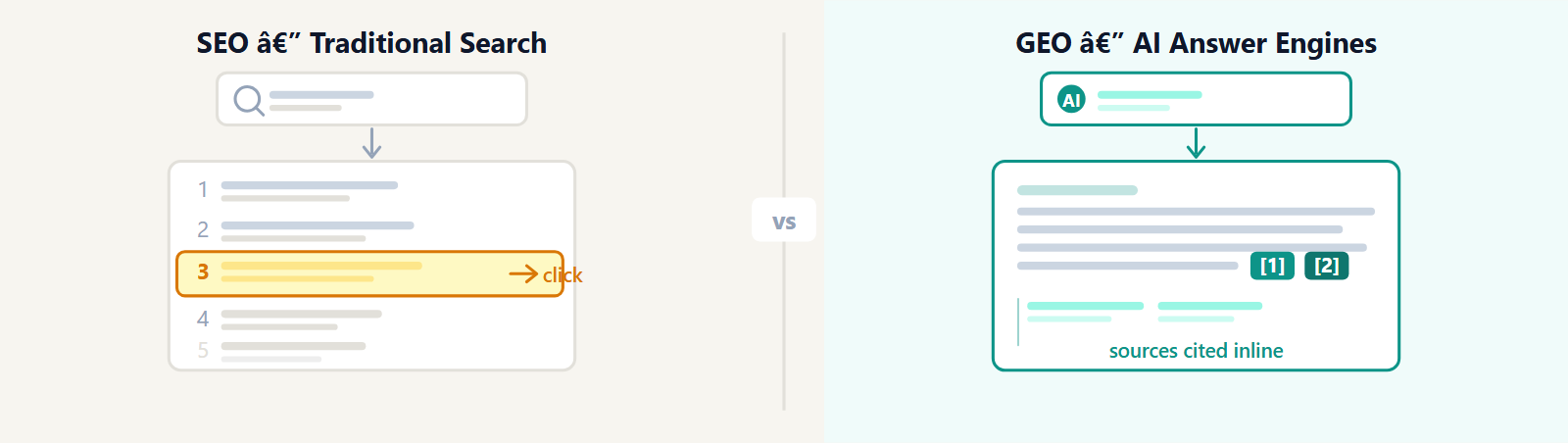
The core difference: ranking vs. retrieval
Classic SEO optimizes for a ranked list of links. A human user sees that list and clicks. Generative engines don't show ten blue links — they synthesize a single answer and cite a few sources inline. The human never sees a rank; they see a summary.
That changes the success metric. In SEO you want position 1. In GEO you want to be one of the sources a model trusts enough to pull from and attribute. There's no rank 1 in a paragraph.
This isn't a complete replacement. Classic search is still the dominant interface for most queries, and ranking well in Google correlates with being in training and retrieval sets. But the optimization target has shifted for a meaningful share of queries, especially informational and comparison ones.
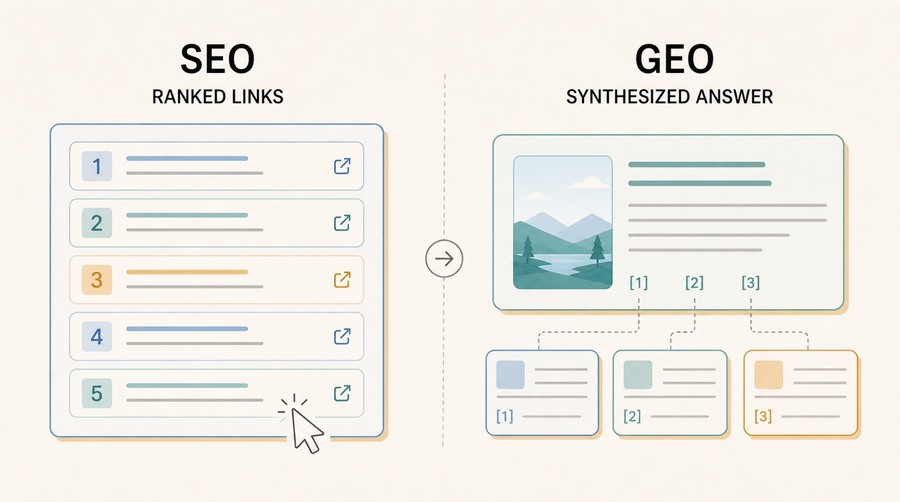
What stays the same
Most of the technical fundamentals carry over:
- Crawlability — if a bot can't fetch your page, neither engine can use it. Clean robots.txt, fast responses, correct status codes.
- Indexable HTML — content must be in the server-rendered markup, not behind JavaScript that a basic crawler won't execute.
- Canonical URLs — duplicate content confuses both Google and retrieval systems. Pick a canonical, redirect correctly, use trailing slashes consistently.
- Page authority — links pointing to your domain are still a proxy for trust. More authoritative domains get pulled more often by RAG systems.
- Structured data — JSON-LD helps both rich results and entity disambiguation by AI systems.
If your SEO fundamentals are weak, GEO won't save you. Fix the foundation first.
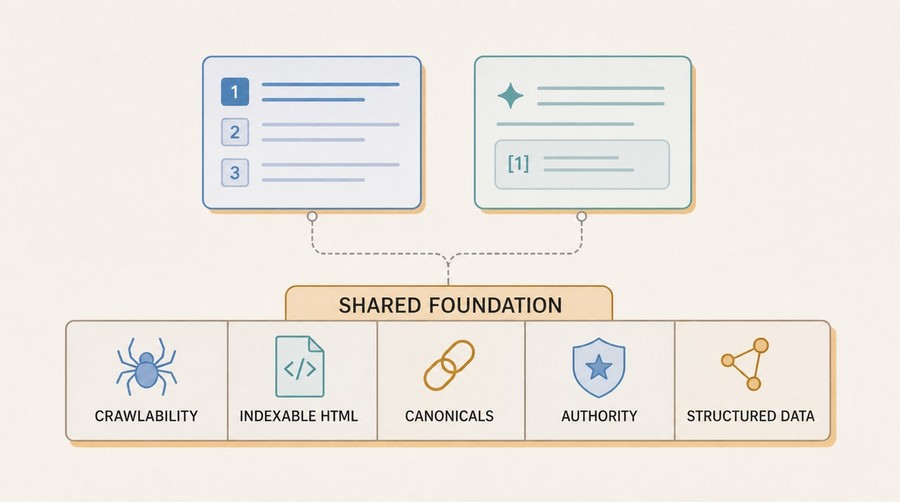
What changes
1. Quotability over keyword density
SEO copywriting obsesses over keyword frequency and placement. GEO cares about whether a passage can be lifted cleanly. A model looking for a definition doesn't want a paragraph that mentions the keyword twelve times; it wants one clear sentence that states what the term means, followed by context.
The shift: write for direct extraction. Lead with the answer. State facts in a form that makes sense out of context.
2. Entity clarity over anchor text
SEO builds link equity through anchor text. GEO needs clear entity associations. Who is your brand? What does it do? What category does it live in? Models build entity graphs from structured data, consistent references across the web, and the way you describe yourself on your own site.
Mark up your Organization and WebSite schema. Be consistent with your brand name, product names, and category language across every page. A Wikipedia article or Wikidata entity helps; not everyone can get that, but it's the clearest signal.
3. Source trust over CTR signals
Google has click-through rate as a behavioral signal. Generative engines don't — they assess source quality through a different lens: content accuracy, domain authority, freshness, and whether the content matches what the model already knows from training. There's no A/B testing your title tag for citation rate the way you would for CTR.
4. llms.txt as explicit context
llms.txt is an emerging standard with no SEO analogue. It's a plain-text file at your domain root that says: "here are my important pages, here's what this site is about." It's not a ranking signal; it's a hint for LLM tools that read it directly. Read our llms.txt implementation guide for details.
5. AI-specific crawler permission
SEO robots.txt blocks Googlebot and Bingbot. GEO requires deliberate decisions about AI crawlers: GPTBot, OAI-SearchBot, ClaudeBot, PerplexityBot, Googlebot. Each engine behaves differently. Blocking them all to protect your content from training also blocks the retrieval that drives citations. (Google-Extended is a separate, training-only signal for Gemini — distinct from Googlebot, and blocking it does not affect citation retrieval.)
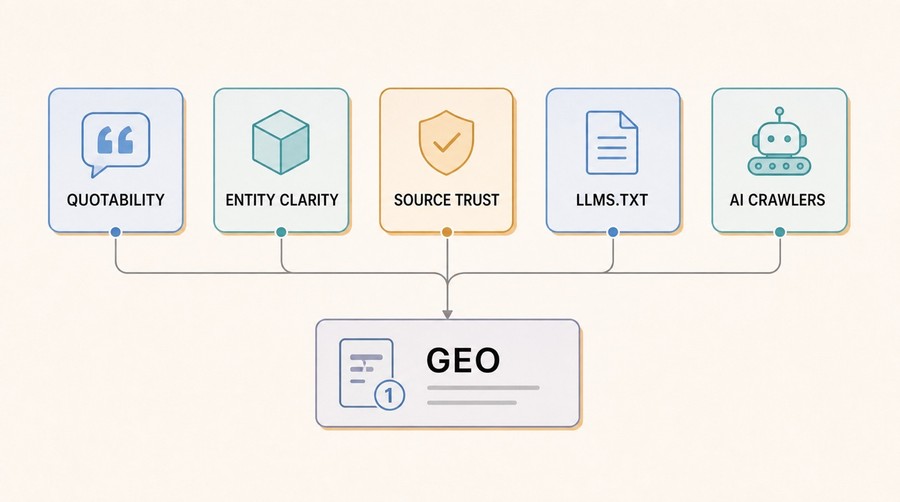
Practical priority: what to do first
If you're already doing solid SEO and want to add GEO, here's where the marginal effort goes:
- Audit your robots.txt for unintentional AI crawler blocks. If you're blocking
GPTBotorPerplexityBot, decide deliberately. - Run a baseline audit to see how your site scores on crawlability, llms.txt, schema, and content signals.
- Rewrite your key pages to lead with direct answers. Check your most important landing pages: does the first paragraph state what you do and for whom, in one clear sentence?
- Add or fix entity schema —
Organization,WebSite,BreadcrumbList. - Create an llms.txt pointing to your most important content. Low effort, makes your key URLs explicit.
- Monitor over time. AI visibility changes as models update. A snapshot tells you where you are; tracking tells you whether changes worked.
What GEO can't do
Be honest with yourself about the limits:
- No one can guarantee a specific model will cite you. Citation behavior is probabilistic and changes as models are retrained.
- You can't directly control what training data includes your content.
- GEO doesn't replace SEO for transactional queries — people still use classic search to buy things, compare prices, and find local services.
- Brand authority built over years of SEO carries over. A two-week sprint won't substitute for it.
GEO removes friction. It doesn't manufacture authority from nothing.
Further reading
- How to make your website appear in ChatGPT and Perplexity sources — the technical and content checklist.
- llms.txt for WordPress and AI visibility — practical implementation guide.
- AI Visibility Checklist — all the signals in one place.
- The signals behind these guides: our research foundation.
- Why we think AI visibility should be auditable — the GEO Optimizer manifesto.
- GEO vs SEO: 7 key differences
Apply this guide
Run an AI SEO audit before you change pages.
Use the audit to find which signal is holding the site back: crawler access, schema, llms.txt, content clarity, AI discovery, or entity strength.
- Best for pages that need a technical and content baseline.
- Next metric: AI readiness score plus the weakest signal category.
Frequently asked questions
What's the core difference between SEO and GEO?
SEO optimizes for a ranked list of links a human clicks through. GEO optimizes for being one of the few sources a generative engine trusts enough to synthesize into a single answer and cite — there's no rank 1 in a paragraph.
Do I need to abandon my SEO work to do GEO?
No. Most technical fundamentals — crawlability, indexable HTML, canonical URLs, page authority, structured data — carry over directly. If your SEO foundation is weak, GEO won't compensate for it.
What changes the most when writing for GEO instead of SEO?
Quotability over keyword density (write for direct extraction, lead with the answer), entity clarity over anchor text, and source-trust signals instead of click-through-rate signals.
Can GEO guarantee a specific AI model will cite my site?
No. Citation behavior is probabilistic and changes as models are retrained — GEO removes friction and improves your odds, it doesn't manufacture authority or guarantee outcomes.
Get the monthly State of GEO report
AI search readiness benchmarks, adoption stats, and the actions that move the needle — delivered monthly. No spam.
By submitting, you agree to receive the monthly GeoReady newsletter: benchmark data from the State of GEO dataset, practical GEO guidance, and product updates. You can unsubscribe anytime. See our Privacy Policy.