How to appear in ChatGPT and Perplexity: a practical guide for 2026
Learn how to make your website appear as a source in ChatGPT, Perplexity, and other AI answer engines. Technical steps, content signals, and what the data says.
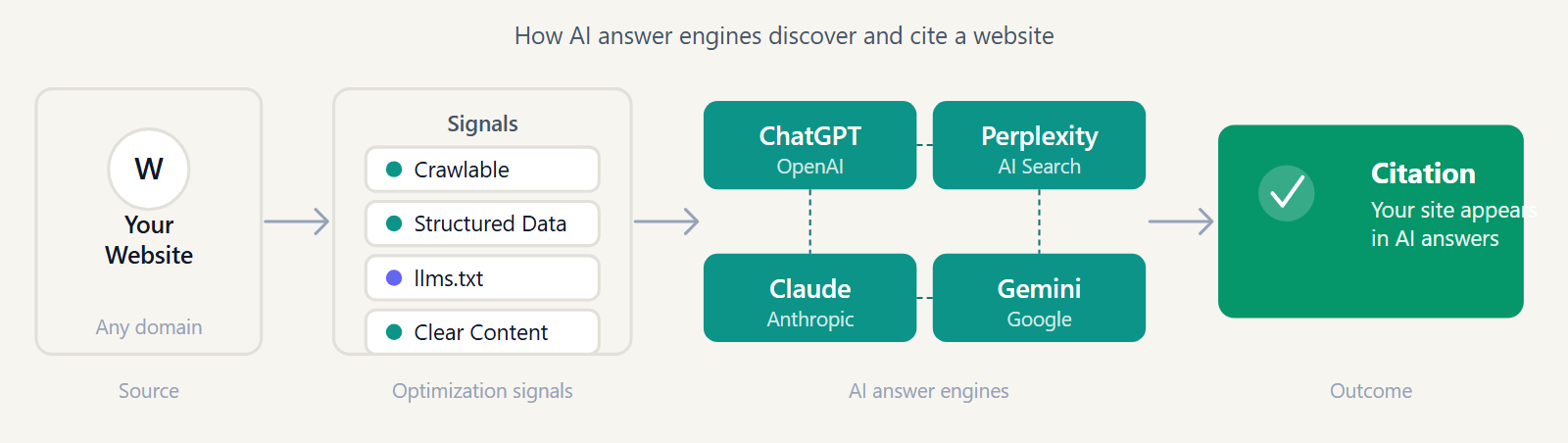
ChatGPT serves over 100 million active users per week. Perplexity is the fastest-growing search alternative in a decade. If your website does not appear as a cited source in their answers, you are invisible to a growing share of your audience — even if you rank on the first page of Google for the same queries.
This guide explains what determines which sites get cited by AI answer engines, and the concrete steps you can take to be selected.
How ChatGPT and Perplexity decide what to cite
AI answer engines do not rank websites the way Google does. They extract answers. The process has two stages: crawling (collecting content) and retrieval (selecting what to include in an answer at query time).
ChatGPT with web search uses OAI-SearchBot to index pages in near real-time. At query time, it retrieves pages whose content most directly answers the question, then cites them. Perplexity uses PerplexityBot and applies a similar extraction model, with a preference for sources that contain direct answers, structured data, and verifiable facts.
The site that wins a citation is not necessarily the highest-authority domain — it is the one with the clearest, most extractable answer to the specific query. Four factors determine this:
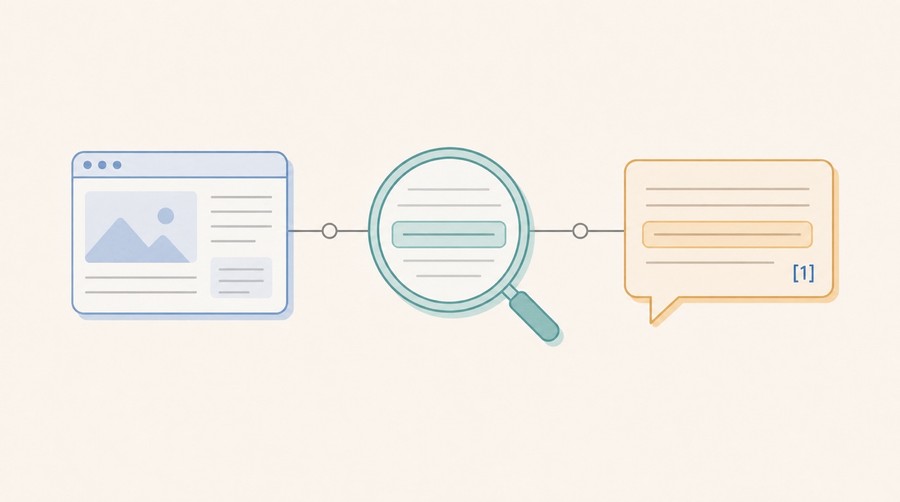
- Crawler access — the bot must be able to reach and read your page
- Content structure — answers must be findable without reading the full page
- Entity signals — the model must know what your site is and trust it
- Schema markup — structured data makes extraction faster and more reliable
Step 1 — Make sure AI crawlers can reach you
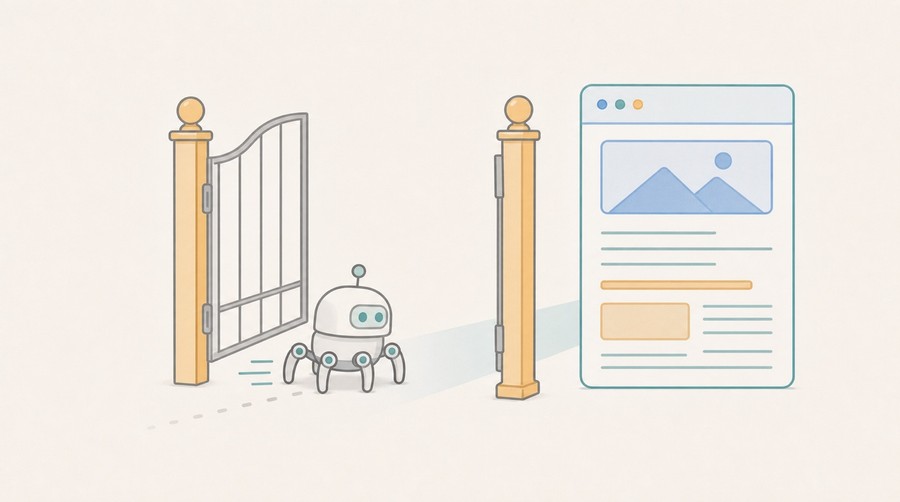
Before any content or authority signal matters, the AI crawler must be able to access your site. Many sites accidentally block AI search bots through overly broad robots.txt rules.
Check your robots.txt file by visiting https://yourdomain.com/robots.txt. Look for any rule using Disallow: / with User-agent: * (wildcard) — this blocks all bots, including AI search crawlers. The bots you need to allow explicitly are:
- OAI-SearchBot — used by ChatGPT for real-time web search
- PerplexityBot — used by Perplexity
- ClaudeBot and Claude-SearchBot — used by Claude
- Bingbot — powers ChatGPT and Copilot retrieval via Bing index
- Google-Extended — Gemini training/grounding only (not a citation source; Google Search and AI Overviews citation runs through Googlebot)
If any of these are blocked, fix your robots.txt before anything else. GeoReady checks crawler access automatically as part of its free audit — it accounts for 18 points out of 100 in the scoring model, the highest single category.
For a complete guide to AI crawlers and robots.txt rules, see AI crawlers and robots.txt: what you need to know.
You can run a free crawler access audit at GeoReady to check your current configuration in under 60 seconds.
Step 2 — Structure your content for extraction
AI engines do not read pages linearly. They scan for the most direct answer to the query. Content structured for extraction scores significantly higher than content structured for reading flow.
What works
- A short definition or answer in the first sentence of each section
- H2 and H3 headings phrased as questions or clear topic labels
- Bullet lists for multi-part answers — easier to extract than paragraphs
- A FAQ section at the bottom — AI engines pull Q&A pairs directly
- Data with attribution — "X% of sites do Y (source)" is highly citable
What does not work
- Dense paragraphs with no clear entry point for scanning
- Jargon without inline definitions
- Content behind login, JavaScript walls, or paywalls
- Vague opener paragraphs — the answer should appear in the first sentence, not the third
The practical rule: the first sentence after each H2 should directly answer the question implied by that heading. If it does not, rewrite it.
Step 3 — Add schema markup
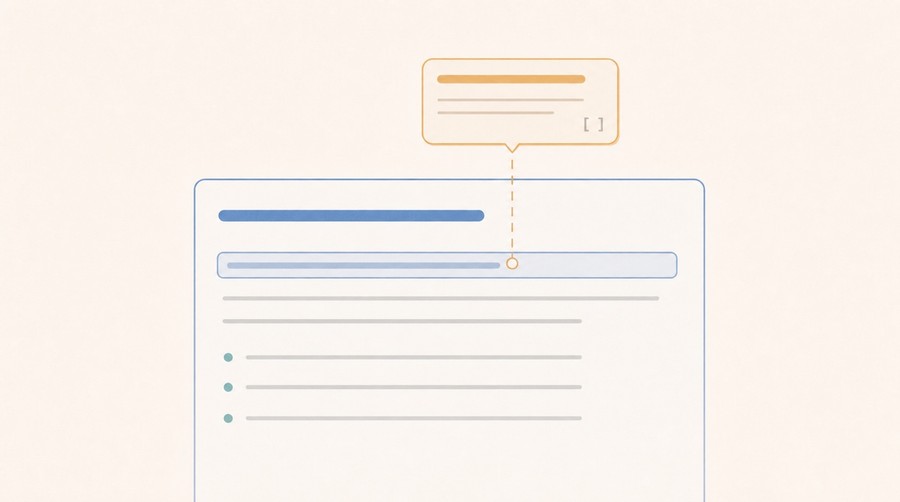
Structured data gives AI systems semantic context that plain text cannot provide. Three schema types have the highest impact on AI citation:
- FAQPage — AI engines extract Q&A pairs directly from FAQPage markup. Adding this to any page with a FAQ section is the fastest schema win.
- HowTo — Perplexity shows structured steps from HowTo schema in its answers. Any guide or tutorial benefits from this.
- Organization — disambiguates your entity. The model needs to know what your site is, who runs it, and whether it is a real organization.
Our June 2026 benchmark of 288 domains found that sites with complete schema markup scored an average of 29 points higher than those without it. Full data in the State of GEO: June 2026 report.
Step 4 — Publish an llms.txt file
llms.txt is a proposed standard for communicating directly with large language models: a machine-readable file at your domain root that provides a structured index of your most important pages, their purpose, and any usage constraints.
It is the single highest-leverage technical change most sites can make. In our June 2026 benchmark, sites with llms.txt scored an average of 24 points higher than those without it.
The file lives at https://yourdomain.com/llms.txt and takes under an hour to create for most sites.
Full implementation guide: What is llms.txt? A practical guide.
Step 5 — Build entity authority
AI models build an internal representation of named entities — organizations, people, products. If your entity is ambiguous or inconsistent across sources, the model may avoid citing you to prevent attribution errors.
- Use your exact brand name consistently across your site, schema, and all external profiles
- Add sameAs links in your Organization schema pointing to verified profiles (LinkedIn, GitHub, Crunchbase, Product Hunt)
- Get listed in directories that AI models already cite — G2, Product Hunt, Capterra, SaaSHub
- Earn mentions in sources the models trust — guest posts on industry publications, press coverage, community threads
Entity authority takes time to build, but it compounds: each additional corroborating source strengthens the model's confidence in your entity.
What the data says — June 2026 benchmark
In the State of GEO June 2026 report, we analyzed 288 domains across industries using the GeoReady audit engine. The findings are stark:
- Average GEO score: 53.6 out of 100
- 79.2% of sites scored below Good (under 70) — most of the web is not ready for AI search
- Only 1.4% of sites reached Excellent (90 or above)
- The two highest-impact signals: llms.txt (+24 points average) and schema markup (+29 points average)
- Crawler access issues — blocked AI bots — were found in a significant share of audited sites
Full data and methodology: State of GEO: June 2026.
How to measure if you're appearing in ChatGPT and Perplexity
Unlike Google rankings, AI citations are not visible in a dashboard by default. Three approaches work:
Manual spot-check
Search for your brand name plus a topic you cover in both ChatGPT (with web search enabled) and Perplexity. Check whether your domain appears as a cited source. Do this across five to ten representative queries.
Structured citation monitoring
Define a fixed set of 10–20 queries relevant to your site and run them monthly. Record citation rate, position, and sentiment. GeoReady's AI Snapshot feature (Pro plan) automates this across ChatGPT, Perplexity, and Claude.
Technical GEO audit
A GEO audit measures all the signals that determine whether you get cited — crawler access, schema, llms.txt, entity signals, content quality — and returns a 0–100 score with specific recommendations.
Run a free GEO audit at GeoReady to see exactly which signals are missing.
To check whether AI engines are currently citing you, use the AI citation checker.
New to GEO? Start with What is Generative Engine Optimization (GEO)? for the foundational concepts before implementing these steps.
Apply this guide
Check whether Perplexity-style answers cite your domain.
Use the citation checker path when the risk is that answer engines quote competitors, review sites, or third-party sources instead of your own pages.
- Best for source-backed answers where the cited URL matters.
- Next metric: direct citations, competitor citations, and missing citations.
Frequently asked questions
How long does it take to appear in ChatGPT after making changes?
Typically weeks to months, depending on how quickly OAI-SearchBot recrawls your site. There is no manual submission process for ChatGPT citations. Making your content clearly extractable and ensuring your robots.txt allows OAI-SearchBot is the fastest path. Changes to schema markup and llms.txt can take effect on the next crawl cycle.
Does Google ranking help with ChatGPT citations?
Indirectly. ChatGPT's web search uses the Bing index, not Google's. A page can appear in ChatGPT citations without ranking on Google at all, as long as it is indexed by Bing and accessible to OAI-SearchBot. That said, strong content quality — which helps Google ranking — also helps AI citation. Verify your Bing Webmaster Tools setup as a separate step from Google Search Console.
Can I pay to appear in ChatGPT results?
No. As of July 2026, ChatGPT Search does not offer paid citation placement. Citations in AI-generated answers are based on content quality, crawlability, and relevance — not advertising. Perplexity similarly does not sell citation positions in its answer engine results.
What is the difference between appearing in ChatGPT and Perplexity?
Different crawlers (OAI-SearchBot for ChatGPT, PerplexityBot for Perplexity) and different retrieval algorithms. In practice, the same optimizations — crawler access, schema markup, clear content structure, llms.txt — improve citation probability in both. The biggest difference is that Perplexity tends to cite more sources per answer and shows them more prominently.
Do I need to be on the first page of Google to be cited by AI?
No. AI search engines crawl independently and use their own retrieval logic. A page that answers a question clearly and is accessible to AI crawlers can be cited even if it ranks on page three of Google. This is one reason GEO is a distinct discipline from SEO — the ranking signals overlap but are not identical.
How do I know which AI bots are visiting my site?
Check your server access logs and filter by User-agent. The key strings to look for: OAI-SearchBot, ChatGPT-User, PerplexityBot, Perplexity-User, ClaudeBot, Claude-SearchBot, Google-Extended, Bingbot. If none of these appear in your logs over a 30-day period, it is likely your robots.txt is blocking them or your site has not yet been discovered.
Get the monthly State of GEO report
AI search readiness benchmarks, adoption stats, and the actions that move the needle — delivered monthly. No spam.
By submitting, you agree to receive the monthly GeoReady newsletter: benchmark data from the State of GEO dataset, practical GEO guidance, and product updates. You can unsubscribe anytime. See our Privacy Policy.