What is Generative Engine Optimization (GEO)?
Generative Engine Optimization makes your site citable by AI answer engines like ChatGPT and Perplexity. Learn what GEO is and how it differs from SEO.
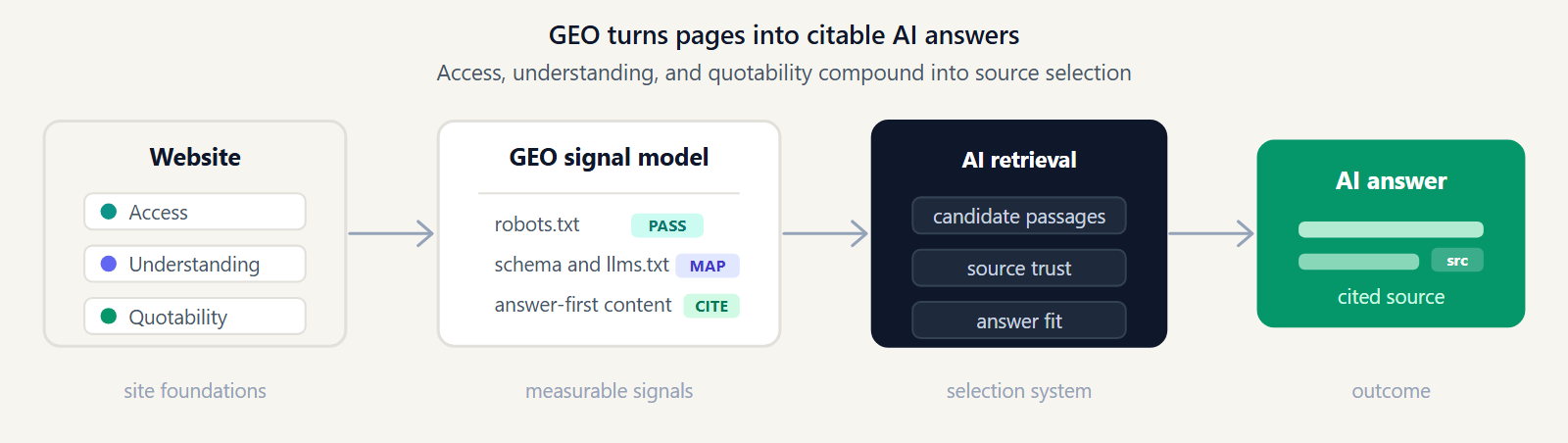
Generative Engine Optimization (GEO) is the practice of structuring your website's content, technical signals, and entity presence so that AI answer engines — ChatGPT, Perplexity, Claude, Gemini, Copilot — can find, understand, and cite you in their responses.
Where traditional SEO targets a ranked list of ten blue links, GEO targets a different output: the synthesized answer that an AI generates directly. The engine reads multiple sources, selects what to cite, and summarizes. GEO is the discipline of being selected.
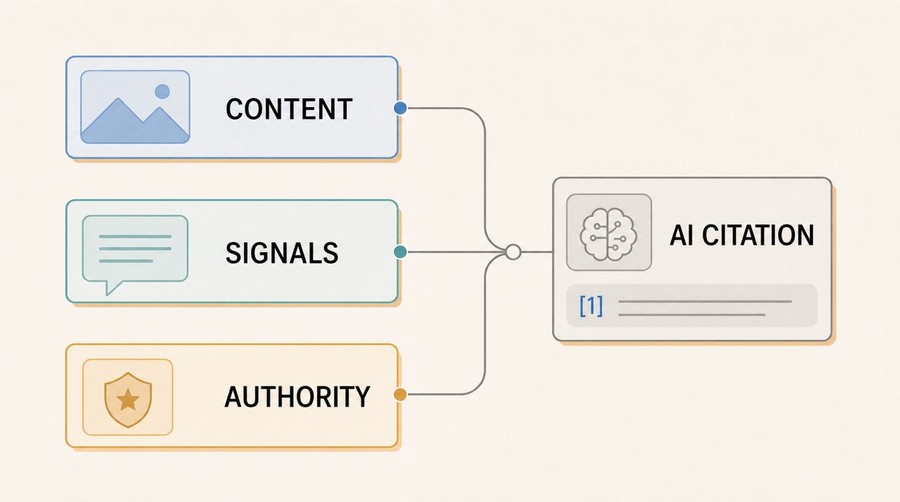
GEO vs SEO: the same goal, a different interface
Search engine optimization and generative engine optimization share the same underlying goal — make your site discoverable by people using search — but the mechanics are fundamentally different.
A Google ranking depends on PageRank signals, backlinks, and keyword match. An AI citation depends on whether the model can extract a clear, factual answer from your content and whether your domain is trusted enough to surface. These overlap, but they are not the same problem.
- SEO: rank in a list. Users choose to click.
- GEO: be cited in an answer. Users receive your content pre-digested.
- SEO: ten results per query, multiple winners. GEO: one answer, two or three sources cited.
- SEO: click-through rate is the main engagement signal. GEO: citation rate is the goal.
For a deeper comparison of the two disciplines, see GEO vs SEO: what changes when AI becomes the interface.
Why GEO matters in 2026
AI-powered search is no longer experimental. ChatGPT handles over 100 million active users per week. Perplexity is the fastest-growing search alternative in a decade. Google's AI Overviews appear above organic results for the majority of commercial queries. Copilot is the default interface on hundreds of millions of Windows devices.
The implication: a meaningful share of the searches your target audience performs now return an AI-generated answer instead of a list of links. If your site is not optimized for citation, you are invisible to that share of the market — even if you rank on page one for those same queries in classic Google Search.
This is not a prediction about the future of search. It is a description of what is already happening in 2026.
The 8 dimensions of GEO
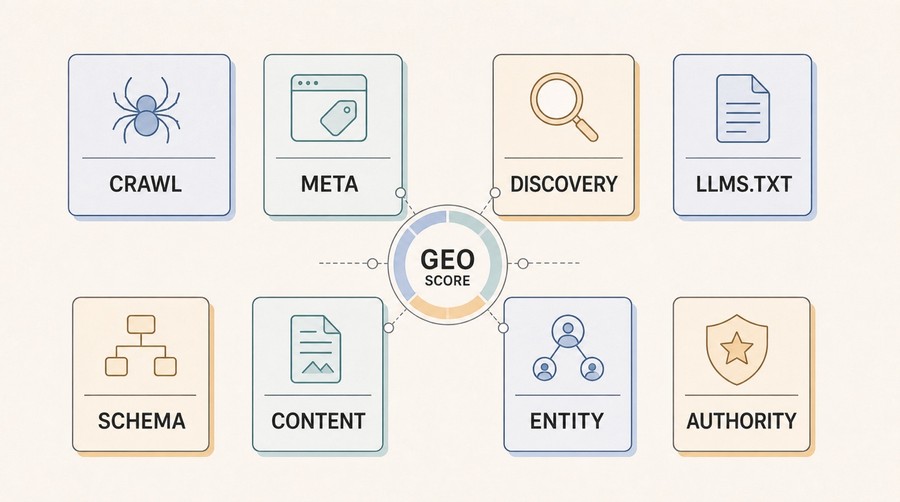
GeoReady measures AI visibility across eight categories, each targeting a different signal that AI crawlers and retrieval systems use to evaluate your site. Together they form a 100-point score.
1. Robots & crawler access (18 points)
AI crawlers — OAI-SearchBot, PerplexityBot, ClaudeBot, Googlebot — must be able to reach your content. robots.txt rules, server-side blocking, and noindex directives that exclude AI bots make you invisible before any content quality signal is evaluated.
2. Meta signals (14 points)
Title tags, meta descriptions, and canonical tags tell AI systems what a page is about and which URL to attribute when citing it. Vague or missing meta signals make extraction unreliable.
3. AI discovery signals (6 points)
Dedicated AI discovery files — llms.txt, ai.txt — give models a structured summary of your site's content and purpose. Sites with llms.txt receive a measurable citation advantage (our benchmark data shows a +24-point average score difference).
4. LLMs.txt presence (18 points)
llms.txt is a proposed standard for communicating with large language models directly: a machine-readable index of your most important pages, their purpose, and any usage constraints. It is the single highest-leverage technical change a site can make for AI visibility.
5. Schema markup (16 points)
Structured data — Organization, Article, FAQPage, HowTo, Product — gives AI systems semantic context that plain text cannot. Sites with complete schema markup score on average 29 points higher in our benchmark than those without it.
6. Content quality signals (12 points)
Factual density, source citation, clear definitions, and consistent named-entity usage determine whether a model treats your content as a reliable source worth quoting. Vague marketing copy scores near zero; data-backed, definitional content scores high.
7. Brand & entity signals (10 points)
AI systems build an internal model of named entities — organizations, people, products. Consistent entity naming across your site, schema, and off-site mentions (directories, Wikipedia, press coverage) strengthens entity disambiguation and increases citation probability.
8. Entity authority (6 points)
Authority signals — external references, corroborating sources, third-party mentions — validate that your entity is real and trustworthy. This is the AI-age equivalent of domain authority: not a ranking factor, but a citation filter.
How to measure your GEO score
Because GEO depends on signals that are distributed across your technical infrastructure, content, and off-site presence, measuring it requires a multi-layer audit rather than a single check.
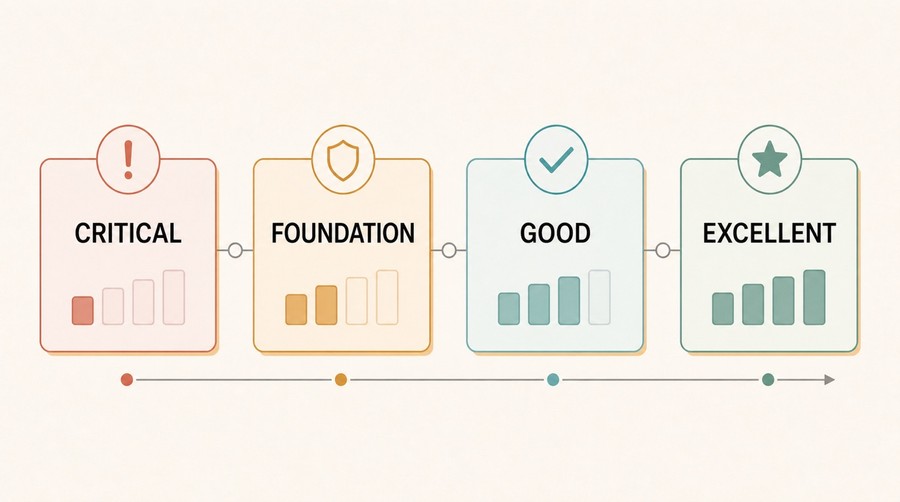
GeoReady runs an automated GEO audit across all eight dimensions above and returns a 0–100 score, a band (Critical / Foundation / Good / Excellent), and per-category breakdowns with specific recommendations. The audit is free for the first run.
You can run a free GEO audit at the GeoReady homepage — it takes under 60 seconds and requires no account.
For a structured self-assessment before the audit, use the AI visibility checklist.
What the data says: GEO scores in 2026
In our June 2026 State of GEO report, we analyzed 288 domains across industries using the GeoReady audit engine. The findings:
- Average GEO score: 53.6 out of 100.
- 79.2% of sites scored below 70. Most of the web is not ready for AI search.
- Sites with llms.txt scored 24 points higher on average than those without it.
- Sites with complete schema markup scored 29 points higher on average.
- Only 1.4% of sites scored 90 or above — comfortably inside the Excellent band, which starts at 86. The ceiling is high and nearly empty.
The full dataset and methodology are available in the State of GEO: June 2026 report.
Three months on, the picture holds. Across the full cohort — 900+ sites audited to date — the average is 54.6 and the median 57, so a score in the fifties remains typical rather than alarming.
How to improve your GEO score
The highest-leverage actions, in order of impact per effort:
- Publish a llms.txt file at your domain root. This is the single highest-impact change for most sites.
- Audit your robots.txt and ensure AI crawlers are explicitly allowed.
- Add Organization schema to your homepage and Article/HowTo schema to content pages.
- Write content with factual density: short definitions, cited data, FAQ sections.
- Use consistent entity naming across your site, schema, and any off-site profiles.
For the complete step-by-step implementation path, see the AI visibility checklist.
For llms.txt specifically, see What is llms.txt? A practical guide.
The research behind GEO
The term "Generative Engine Optimization" was first used in peer-reviewed research published by Aggarwal et al. (Princeton, Georgia Tech, IIT Delhi) in 2024. The paper identified nine content modification strategies that increased citation rates in AI-generated responses, including adding statistics, citing authoritative sources, using fluent language, and including quotations.
GeoReady's scoring system is built on this research and on our own empirical findings from auditing thousands of sites. The methodology is documented on the GeoReady research page.
Apply this guide
Run an AI SEO audit before you change pages.
Use the audit to find which signal is holding the site back: crawler access, schema, llms.txt, content clarity, AI discovery, or entity strength.
- Best for pages that need a technical and content baseline.
- Next metric: AI readiness score plus the weakest signal category.
Frequently asked questions
What does GEO stand for?
GEO stands for Generative Engine Optimization — the practice of making your website visible and citable to AI answer engines like ChatGPT, Perplexity, Claude, and Gemini.
Is GEO the same as SEO?
No. SEO focuses on ranking in traditional search engine result pages. GEO focuses on being cited in AI-generated answers. They share some foundations — good content, technical accessibility, entity signals — but GEO requires additional work: llms.txt, AI-crawler access, schema markup, and content structured for extraction rather than clicks.
How do I know if my site is optimized for AI search?
Run a GEO audit. GeoReady checks all eight dimensions of AI visibility — crawler access, meta signals, llms.txt, schema, content quality, entity authority — and returns a 0–100 score with specific recommendations. The first audit is free.
What is a good GEO score?
Across 900+ sites audited by GeoReady, the average score is 54.6 and the median is 57 — a score in the fifties is ordinary rather than alarming. On the open-source rubric, 68–85 is Good and 86–100 is Excellent, while 36–67 is Foundation and 0–35 is Critical. Clearing 68 means the basics are in place: AI crawler access, structured data, and an llms.txt file. The live distribution is on the State of GEO benchmark.
Does GEO replace SEO?
No. GEO and SEO are complementary. Google still drives significant traffic from traditional search, and Google itself is adding AI Overviews to its results. The most defensible strategy is to optimize for both: strong SEO fundamentals plus the GEO-specific signals (llms.txt, AI-crawler access, schema, entity signals) that determine citation in AI answers.
What is llms.txt and why does it matter for GEO?
llms.txt is a proposed standard — a machine-readable file at your domain root that gives AI models a structured index of your content, its purpose, and any usage constraints. Our benchmark data shows that sites with llms.txt score 24 points higher on average than those without it, making it the single highest-leverage GEO action for most sites.
Who invented the term GEO?
The term Generative Engine Optimization was introduced in a 2024 research paper by Aggarwal et al. from Princeton, Georgia Tech, and IIT Delhi. The paper identified specific content strategies that increase citation rates in AI-generated responses and laid the empirical foundation for GEO as a discipline.
Get the monthly State of GEO report
AI search readiness benchmarks, adoption stats, and the actions that move the needle — delivered monthly. No spam.
By submitting, you agree to receive the monthly GeoReady newsletter: benchmark data from the State of GEO dataset, practical GEO guidance, and product updates. You can unsubscribe anytime. See our Privacy Policy.