State of GEO: AI Search Readiness Benchmark
A live benchmark from sites audited by GeoReady, showing how prepared websites are for AI search, citations,llms.txt, and structured data. Every site is scored with the same open-source 100-point rubric. This is an audited sample, not a survey of the whole web.
Live audited sample·aggregated & anonymized·last updated continuously

Scope
Audited sites
Rubric
Open, 100 points
Privacy
Anonymized
Expanded command-center concept: readiness score, crawler access, citation flow, recommendations, alerts, and trend history in one visual surface.
Key findings
GET /api/public/benchmark · live
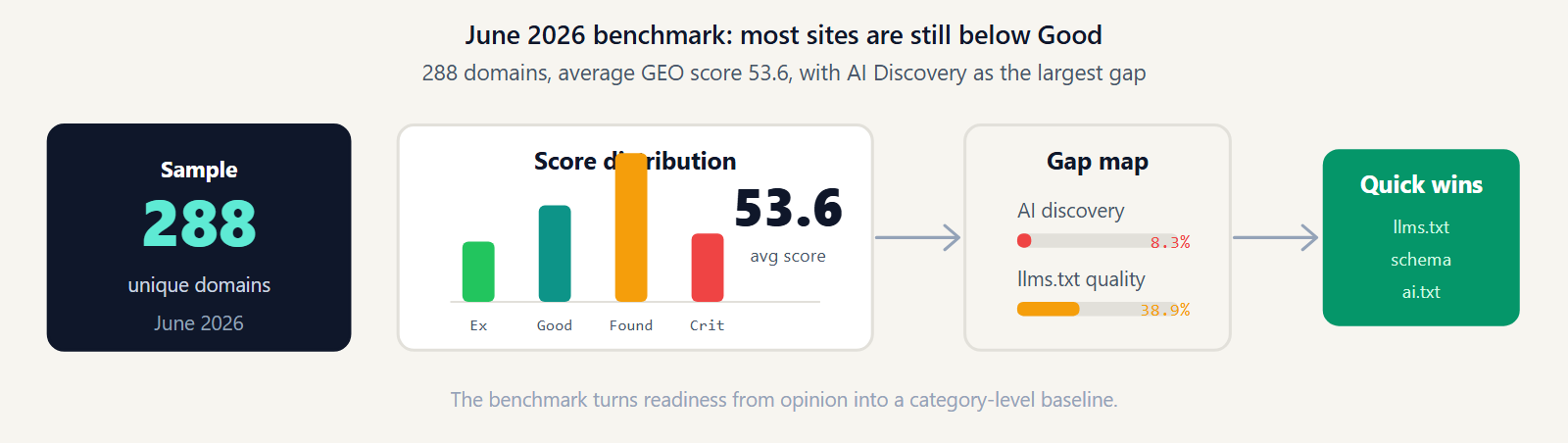
Across sites audited by GeoReady, the basics of AI search readiness (AI crawler access, an llms.txt, and structured data) are still missing more often than not. The live numbers below show the current average and median GEO score and adoption rates, updated as new audits run and counting the most recent audit per domain.
What this means
Among sites that bothered to measure, most are still leaving easy AI visibility points on the table. The gaps are rarely about content quality; they are about machine legibility. AI answer engines cannot cite what they cannot reach, parse, or trust, and the cheapest wins sit in those three layers.
Two signals do much of the work. An llms.txtfile orients AI tools toward your important pages, and validJSON-LD schema lets a model disambiguate your brand and lift clean answers. Across audited sites both are still underused, and both are among the cheapest, fastest fixes: a weekend of work, not a quarter.
AI discovery files are often among the weakest signals. Files like/.well-known/ai.txt and anllms.txt are trivial to publish yet rarely present, so a site that ships them moves ahead of much of the audited sample with very little effort. For marketing, SEO, and dev teams, AI search readiness is mostly hygiene you can act on this week.
How to improve your score
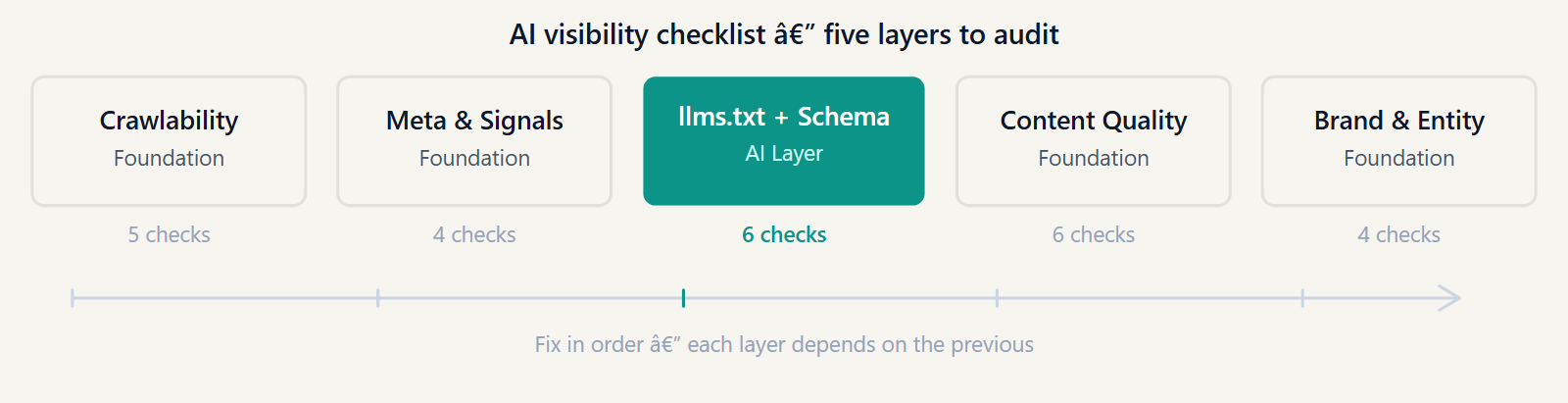
To improve a GEO score: allow AI crawlers intentionally, publish anllms.txt, addOrganization andWebSite JSON-LD, lead key pages with a direct answer, expose product and pricing facts in machine-readable form, and re-audit over time. None of it requires guessing at a model’s internals. It is the machine-readable groundwork that lets AI engines find, parse, and trust a page. Work top to bottom:
- Allow AI crawlers intentionally. Audit your
robots.txtso you are not silently blockingGPTBot,ClaudeBot, orPerplexityBotby accident. - Publish an llms.txt at your domain root that points to your most important pages. Build a starter with the freellms.txt generator.
- Add structured data. Use valid
Organization,WebSite, and where it genuinely fitsFAQPageorArticleJSON-LD, with consistent brand naming. - Improve answer-first content blocks. Open key pages with a direct, self-contained answer a model can lift cleanly, before the marketing context.
- Expose product and pricing info in machine-readable form.Make the facts an AI needs to describe you available in plain HTML and schema, not buried in images or scripts.
- Run recurring audits. AI behavior shifts as models update, so a one-time snapshot tells you where you are while monitoring tells you whether your changes worked.
See where your site stands
The averages above are the baseline to beat across audited sites. A free audit gives you your GEO score in seconds, then the gap analysis tells you which category recovers the most points first.
Methodology
This benchmark is built from sites audited by GeoReady, scored with the open-source GEO Optimizer engine. The numbers are aggregated and anonymized: the public dataset is intentionally summarized, and the full internal analytics are not published. It is a directional signal across an audited sample, not a claim about the entire web.
- Audited sites only. This is a benchmark of sites audited by GeoReady, not a sample of the whole web.
- One row per domain. Only the most recent audit per domain counts, so re-audits don’t inflate the cohort.
- Scheduled monitoring excluded. Only user-initiated audits (web, CLI, API, tools) count.
- Aggregated & anonymized. Domains are stored as salted hashes; this page and its public endpoint expose aggregates only.
- Same engine for everyone. The open-source engine’s 100-point score. The current default rubric (v2, since engine 4.19.0) has nine categories: Google AI readiness, robots, schema, content, brand & entity, meta, llms.txt, signals, AI discovery. Audits run on older engine versions used the eight-category v1 rubric.
- Public data is summarized on purpose. Per-category breakdowns and exact distributions stay internal; the public figures are headline aggregates.
The signals behind every category are documented in ourGEO guideand research foundation. The dataset grows with every audit: run one and you are (anonymously) in it.
September 2026: Full report published
State of GEO: September 2026
704 unique domains. Average score 56.2/100, flat (−0.2), while the sample grew from 282 to 704. Scored across four engine versions, so month-over-month deltas are indicative. AI-crawler blocking fell back to 8.8%, and AI Discovery is the lowest category for the fourth month running.
The September 2026 snapshot covers 704 domains audited 1-30 September; the live counter above includes sites audited since, so the two numbers will differ.
Read the September 2026 reportEarlier editions
- State of GEO: August 2026282 domains · avg 56.4/100 · up 2.3 points, the biggest month-over-month jump yet; llms.txt rebounded to 62.8%.
- State of GEO: July 2026360 domains · avg 54.1/100 · schema +5.5pp, llms.txt −4.1pp. This is the first month-over-month comparison.
- State of GEO: June 2026288 domains · avg 53.6/100 · AI Discovery at 8.3% efficiency. The baseline report that started the series.
Get the October 2026 report when it drops
The State of GEO publishes monthly. Each edition tracks score trends, adoption rates, and the evolving gap between what sites publish and what AI engines can actually read.
By submitting, you agree to receive the monthly GeoReady newsletter: benchmark data from the State of GEO dataset, practical GEO guidance, and product updates. You can unsubscribe anytime. See our Privacy Policy.
FAQ
What is the State of GEO benchmark?
The State of GEO benchmark is a live, anonymized snapshot of how prepared websites are for AI search, measured across sites audited by GeoReady. Every site is scored by the open-source GEO Optimizer engine on a 100-point rubric. The default rubric has nine categories since engine 4.19.0; earlier monthly editions were scored on the eight-category v1 rubric and are labelled as such.
What is a good GEO score?
On the open-source GEO rubric, 86-100 is excellent, 68-85 is good, 36-67 is foundation, and 0-35 is critical. A good score means a site has cleared the basics (AI crawler access, structured data, and an llms.txt) and is legible to AI answer engines. The live average above is the baseline to beat across audited sites.
How is AI search readiness measured?
AI search readiness is measured across nine categories in the current rubric (v2): Google AI readiness, robots.txt and AI crawler access, schema JSON-LD, content quality, brand and entity clarity, meta tags, llms.txt, technical signals, and AI discovery files. Each category contributes to a single 0-100 GEO score using the same open-source engine for every audited site, so results are comparable.
Why does llms.txt matter?
An llms.txt file at your domain root gives AI tools a structured, human-readable map of your most important pages. It is an orientation file, not a confirmed ranking factor, but it is one of the clearest signals that a site has thought about AI discovery. Across audited sites, llms.txt adoption is still low, which makes it an easy early advantage.
Is this benchmark representative of the whole web?
No. This is a benchmark of sites audited by GeoReady, not a survey of the whole web. The audited sample skews toward teams already curious about AI visibility, so it is best read as a directional signal among sites that opted to measure readiness. It is not a universal statistic about every website that exists.
How can I improve my site’s AI visibility?
Start with a free audit to see your GEO score and the category costing you the most points. Then allow AI crawlers intentionally, publish an llms.txt, add Organization and WebSite schema, lead key pages with a direct answer, and expose product and pricing details in machine-readable form. Re-audit over time, because AI behavior shifts as models update.
Beat the benchmark
Run a free AI SEO audit to get your GEO score across all nine categories, see your biggest gap, and turn this benchmark into a to-do list. No account needed for the baseline snapshot.
New to AI search readiness? Start withwhat AI SEO is, then what llms.txt isand the full GEO guide.
