AI SEO: make the page easy to find, parse, and cite.
AI SEO is the practice of optimizing a website so AI search engines like ChatGPT, Perplexity, Claude, and Gemini can find, understand, and cite its content inside generated answers.
Published June 2026 · 11 min read
Access
Meaning
Citation
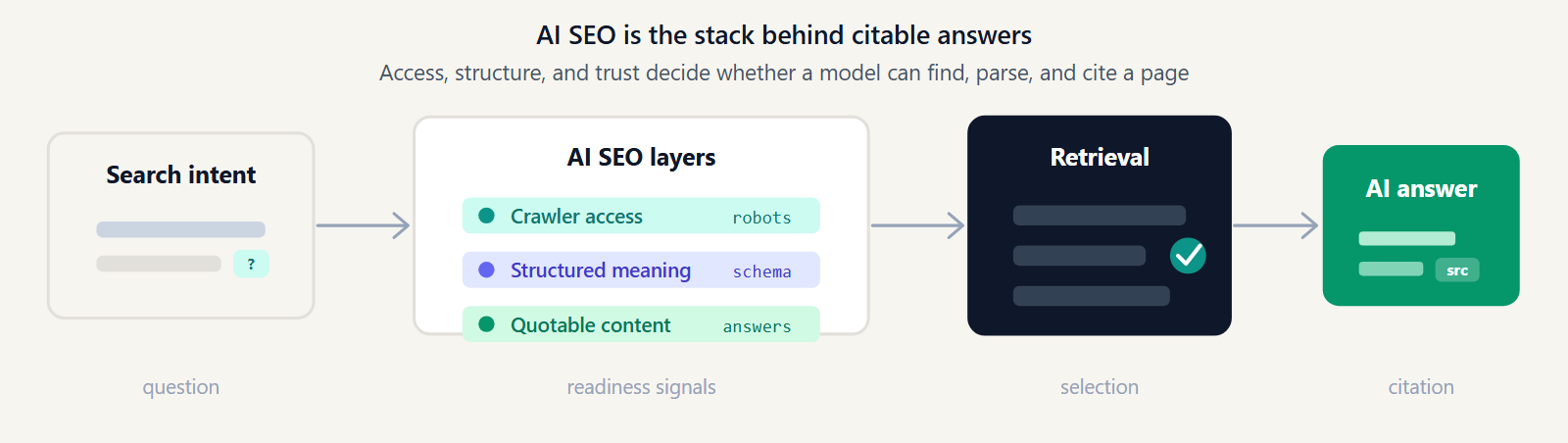
Turn the concept into a measurable check.
High-intent checks
If you already know the AI SEO basics, start with the surface closest to your question: audit readiness, ChatGPT-style visibility, or source-backed Perplexity citations.
What is AI SEO?
AI SEO is the set of techniques that make a website readable, trustable, and citable by AI answer engines. When someone asks ChatGPT, Perplexity, Claude, or Gemini a question, the model does not return ten blue links. It returns a written answer and, increasingly, attributes a handful of sources inline. AI SEO is the work of becoming one of those sources.
The category exists because user behavior is shifting. A meaningful share of informational, comparison, and "how do I" queries now start inside an AI assistant rather than a search box. If your content is invisible or illegible to those systems, you lose presence at the exact moment a potential customer is forming an opinion, even if you rank well in a conventional engine.
AI SEO spans technical access (can an AI crawler fetch your page?), structure (can a model parse and quote it?), and trust (does the model treat your site as a credible source?). The rest of this hub breaks those layers down, and links to deeper guides for each. If you are new to the topic, the broad arc fromSEO to AI-era optimizationis the best place to start.
How AI SEO differs from traditional SEO
AI SEO and traditional SEO share a foundation but optimize for different outcomes. Classic SEO wants position one in a ranked list a human clicks through. AI SEO wants inclusion in a single answer the model writes, where there is no rank one, only sources the model trusted enough to pull from.
Here is what carries over from SEO unchanged:
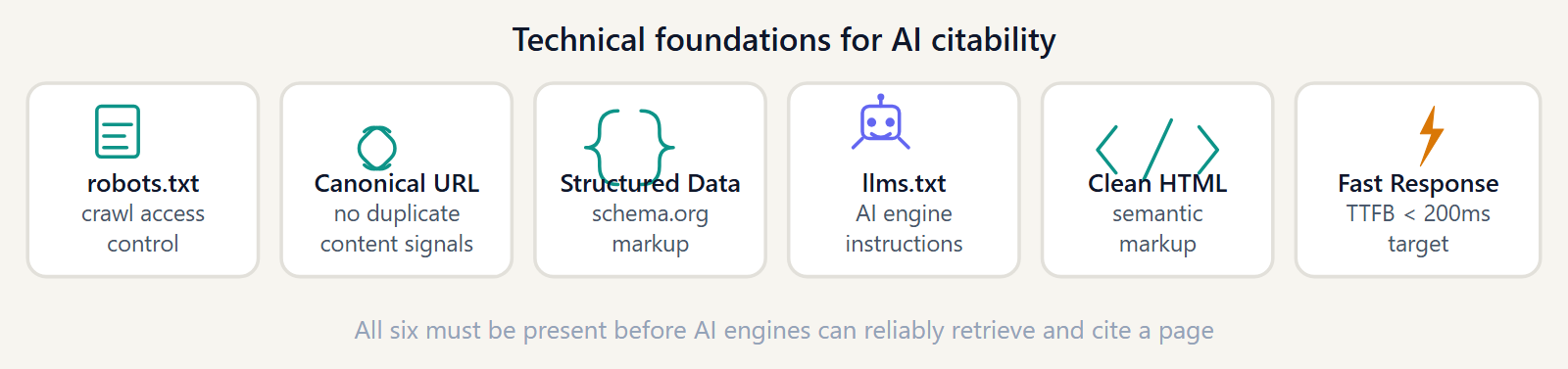
- Crawlability: if a bot cannot fetch your page, no engine can use it. Clean
robots.txt, fast responses, correct status codes. - Indexable HTML: content must live in server-rendered markup, not behind JavaScript a basic crawler will not execute.
- Canonical URLs: duplicate content confuses both Google and retrieval systems. Pick a canonical and redirect consistently.
- Domain authority: links to your domain are still a proxy for trust. More authoritative domains get pulled more often by retrieval systems.
- Structured data:
JSON-LDhelps both rich results and entity disambiguation by AI systems.
And here is what changes once an AI answer is the interface:
- Quotability over keyword density: models lift clean, self-contained passages. Lead with the answer instead of repeating a keyword twelve times.
- Entity clarity over anchor text: models build entity graphs from consistent naming and structured data, in addition to link anchors.
- Source trust over click-through rate: there is no CTR signal to optimize. Models assess accuracy, freshness, and consistency with what they already know.
- AI crawler permissions:
robots.txtnow has to make deliberate decisions aboutGPTBot,ClaudeBot,PerplexityBot, andGoogle-Extended.
For a full side-by-side of the overlap and the divergence, see our dedicated GEO vs SEO guide.
Where GEO fits into AI SEO
The terminology around this space is noisy, so it helps to separate three things that are often used interchangeably:
- AI SEO is the market category, the umbrella term for "making a site visible in AI search." It is the language buyers, agencies, and content teams use to describe the goal.
- GEO (Generative Engine Optimization) is the technical discipline inside that category. It names the concrete, measurable signals (crawler access, structured data, quotable content structure, entity clarity, freshness) that influence whether a model can find, parse, and trust a page.
- GeoReady is the audit, checker, and platform layer that turns GEO into something you can measure and act on: it scores a URL across those signals and tells you what to fix.
In short, AI SEO is the goal, GEO is the technical work, and a tool like GeoReady is where you measure it. The discipline of GEO is research-grounded: work such as the Princeton GEO study (KDD 2024) and ongoing academic exploration like AutoGEO (arXiv:2510.11438, preprint) explores which content and structural changes tend to improve how generative engines treat a source. We treat those findings as directional. They do not prove any guaranteed outcome.
If you want the discipline itself in depth, read our explainer ongenerative engine optimization. The signals behind every recommendation here are documented in ourresearch foundation.
What AI search engines need to understand and cite a page
AI answer engines work through some combination of training data and live retrieval. To be useful to either, a page generally needs to clear three gates: it has to be accessible, parseable, and trustworthy.
1. Accessible: the crawler can reach it
AI systems use named crawlers such as GPTBot,OAI-SearchBot, ClaudeBot, and PerplexityBot. Yourrobots.txt decides which ones may fetch your content. Blocking them all to keep your content out of training also blocks the retrieval that makes citations possible, so the decision should be deliberate, not accidental.
2. Parseable: the model can extract clean meaning
Content should live in server-rendered HTML with a clear heading hierarchy, descriptive titles, and self-contained passages. Structured data in JSON-LD, especiallyOrganization, WebSite,Article, and FAQPage, helps a model disambiguate entities and lift answers cleanly. Anllms.txt file at your domain root can orient LLM tools toward your most important pages; it is an orientation file, not a confirmed ranking factor.
3. Trustworthy: the model treats the source as credible
Trust comes from accuracy, consistency, freshness, and corroboration across the web. Consistent brand and product naming, a clear About and Contact presence, factual claims that match what the model already knows, and recency signals all contribute. There is no single switch: trust is the accumulation of many small, consistent signals over time.
AI SEO audit checklist
Use this as a quick self-audit. Each item maps to a concrete, checkable signal:
- AI crawler access: confirm your
robots.txtdoes not unintentionally blockGPTBot,ClaudeBot, orPerplexityBot. - Server-rendered content: your main copy appears in the raw HTML, not only after client-side JavaScript runs.
- Answer-first structure: key pages open with a direct, extractable answer in the first paragraph.
- Entity schema: valid
OrganizationandWebSiteJSON-LD, with consistent brand naming. - Topical schema:
ArticleandFAQPagemarkup where it genuinely matches the content. - llms.txt: a maintained
llms.txtat the root pointing to your most important pages. - Freshness signals: visible publish and update dates, plus an active sitemap with accurate
lastmodvalues. - Monitoring: a baseline score and a way to track whether changes moved the needle, since model behavior shifts over time.
For the long-form version with pass/fail criteria, see theChatGPT and Perplexity sources checklist, and for the implementation details of orientation files, thewhat is llms.txt guide. You can also build a starter file with the freellms.txt generator.
Common AI SEO mistakes
Most AI SEO problems are self-inflicted. The frequent ones:
- Blocking AI crawlers by default: a blanket disallow in
robots.txtquietly removes you from retrieval-based engines. - Hiding content behind JavaScript: if the answer only renders client-side, many crawlers never see it.
- Keyword stuffing instead of clarity: dense keyword repetition makes passages harder to lift, not easier.
- Inconsistent entity naming: calling your product three different things across pages weakens the entity graph a model builds.
- Treating llms.txt as a magic ranking switch: it is an orientation file, useful but not a guarantee of inclusion.
- Chasing AI SEO before fixing SEO fundamentals: weak crawlability and thin content will not be rescued by an llms.txt file.
What AI SEO cannot promise
The limits of this category are worth stating, because the market is full of overclaiming. AI SEO is a young, fast-moving field built on systems that are partly opaque and frequently retrained. Several things are simply outside anyone's control:
- No one can guarantee a specific model will cite you. Citation is probabilistic and changes with each retraining and index update.
- You cannot directly control which training datasets include your content.
- Improvements are correlational and research-grounded. Cause and effect is not proven for any individual page.
- Measurement is still maturing: at best you can observe directional signals such as AI referral traffic, not a precise citation count.
AI SEO removes friction so a model can find, parse, and trust your content. It does not create authority from nothing, and any tool or agency promising guaranteed citations or rankings is overstating what the field can deliver.
How GeoReady helps
GeoReady turns the GEO discipline into something measurable. You enter a URL and get a score across the signal categories described above (crawlability and AI crawler access, llms.txt, structured data, content signals, AI discovery, and brand and entity clarity), with concrete, prioritized fixes for each gap.
The free audit needs no account and returns a snapshot of where you stand. A GeoReady account adds the parts that matter over time: saved reports, tracking across audits so you can see whether a change moved your score, and the full breakdown of every signal. Because AI behavior shifts as models update, a one-time snapshot tells you where you are while monitoring tells you whether your work is paying off.
GeoReady is built on an open-source toolkit and a transparentresearch foundation; the scoring weights and checks are documented. If you are comparing plans, the pricing pagelays out what the free tier covers and where paid monitoring begins.
Guides & tools
This page is the hub for AI SEO. Below is every guide and free tool we maintain, grouped by what you are trying to do.
Start here
- Generative Engine Optimization: the pillar guide to the discipline behind AI SEO.
- GEO vs SEO: what stays the same and what changes when AI engines become the interface.
- How to improve AI visibility: a step-by-step plan from baseline audit to monitoring.
- Scoring methodology: how the nine signal categories are weighted, with the points behind each.
Implementation guides
- What is llms.txt: what the orientation file does, with a concrete example.
- llms.txt for WordPress: implementing the file manually or with a plugin.
- llms.txt generator for WordPress: generate the file, publish it at the root, then audit AI discovery.
- Appear in ChatGPT and Perplexity sources: the full content and technical checklist.
- AI visibility checklist: every technical and content signal in one place, with pass/fail criteria.
- How to check if AI engines cite your brand: a practical method for ChatGPT and Perplexity.
Authority & advanced
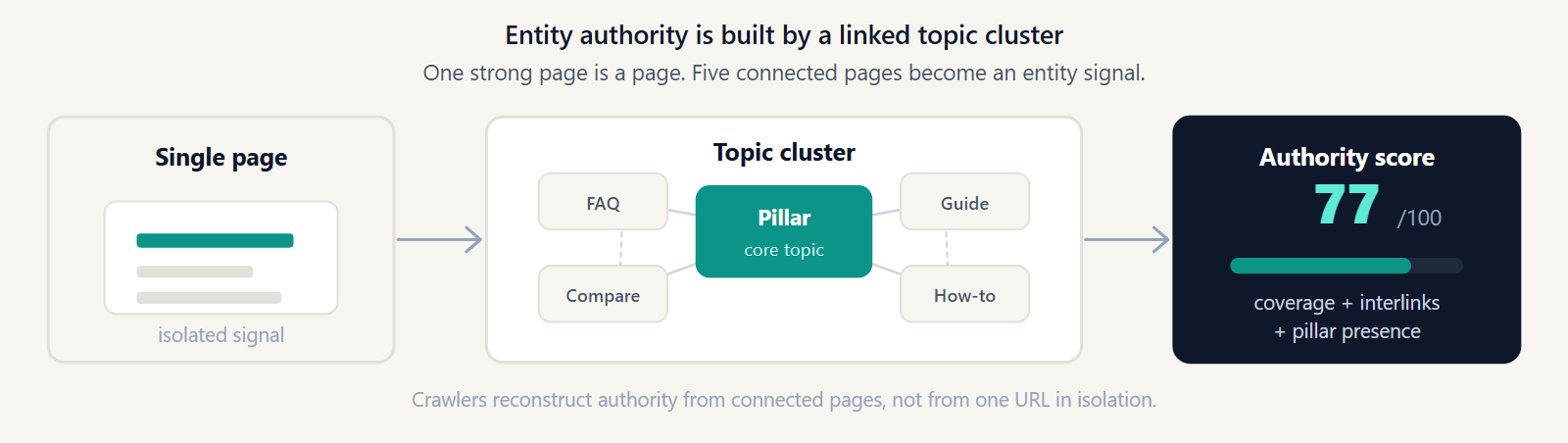
- Entity-based authority: why multi-page topic coverage beats a single strong page.
- Multimodal GEO: making images and video citable by AI engines.
Free tools & comparisons
- AI Citation Checker: check whether your brand is cited in AI answers.
- llms.txt generator: build a starter llms.txt from your sitemap.
- Best GEO tools: how to choose a generative engine optimization tool.
FAQ
Is AI SEO the same as traditional SEO?
No. Traditional SEO optimizes for ranking in a list of links on a results page. AI SEO optimizes for being understood, summarized, and cited inside an AI-generated answer. They share technical foundations like crawlability and structured data, but the success metric is different: position versus inclusion in a synthesized response.
Does AI SEO replace SEO?
Not for most sites. Classic search is still the dominant interface, and ranking well in Google correlates with being available to retrieval and training systems. AI SEO is an additional layer for the growing share of informational and comparison queries that AI answer engines now handle, not a wholesale replacement.
Can AI SEO guarantee my site gets cited by ChatGPT?
No. Citation behavior is probabilistic and changes whenever a model is retrained or its retrieval index updates. AI SEO reduces friction so a model can find, parse, and trust your content, but no tool or agency can guarantee a specific citation. Treat anyone promising guaranteed citations or rankings with skepticism.
What is the difference between AI SEO and GEO?
AI SEO is the broad market category for making sites visible in AI search. GEO, or Generative Engine Optimization, is the technical discipline inside that category: the concrete signals such as crawler permissions, structured data, quotable content, and entity clarity that influence whether a model can use your page. AI SEO is the umbrella; GEO is the engineering.
Is llms.txt a ranking factor?
No, llms.txt is not a confirmed ranking factor. It is an emerging orientation file that lists your important pages and explains what your site is about for LLM tools that read it directly. Think of it as a hint that helps models orient, not a guarantee of inclusion or higher placement.
How do I start with AI SEO?
Begin with a baseline audit so you know where you stand on crawlability, AI crawler permissions, structured data, content signals, and llms.txt. Fix the technical foundation first, rewrite key pages to lead with direct answers, add Organization and WebSite schema, then monitor over time because AI visibility shifts as models update.
Run a free AI visibility audit
See how your site scores across eight AI SEO signal categories (crawlability, llms.txt, schema, content signals, AI discovery, and more). No account needed for the baseline snapshot.
Want to save reports and track changes over time? You cancreate a GeoReady accountor browse all our AI visibility guides first.
Further reading
- GEO vs SEO: what stays the same and what changes when AI engines become the interface.
- Generative Engine Optimization: the technical discipline behind AI SEO, in depth.
- Appear in ChatGPT and Perplexity sources: the full content and technical checklist.
- What is llms.txt: what the file does and how to implement it.
- The signals behind these recommendations: our research foundation, and all the walkthroughs in one place under guides.