Generative Engine Optimization: A Practical Guide to GEO
Learn what Generative Engine Optimization is, how GEO differs from SEO, and how to make your site crawlable, understandable and citable by AI search engines.
What is Generative Engine Optimization?
Generative Engine Optimization is the work of making content easy for AI systems to find, parse, and reuse when they assemble an answer. Where classic search returns ten links and lets the person choose, a generative engine reads multiple sources, synthesizes one response, and attributes a handful of them inline. GEO is about becoming one of those trusted, quotable sources.
The term gained traction with research like the Princeton GEO paper at KDD 2024, which studied how content changes affect visibility in generative responses, and later work such as AutoGEO. The findings are research-grounded directional signals — not proof that a single tactic guarantees a citation — but they point consistently toward the same idea: clarity, structure, and extractability matter more than keyword density. See our research foundation for the sources behind these signals.
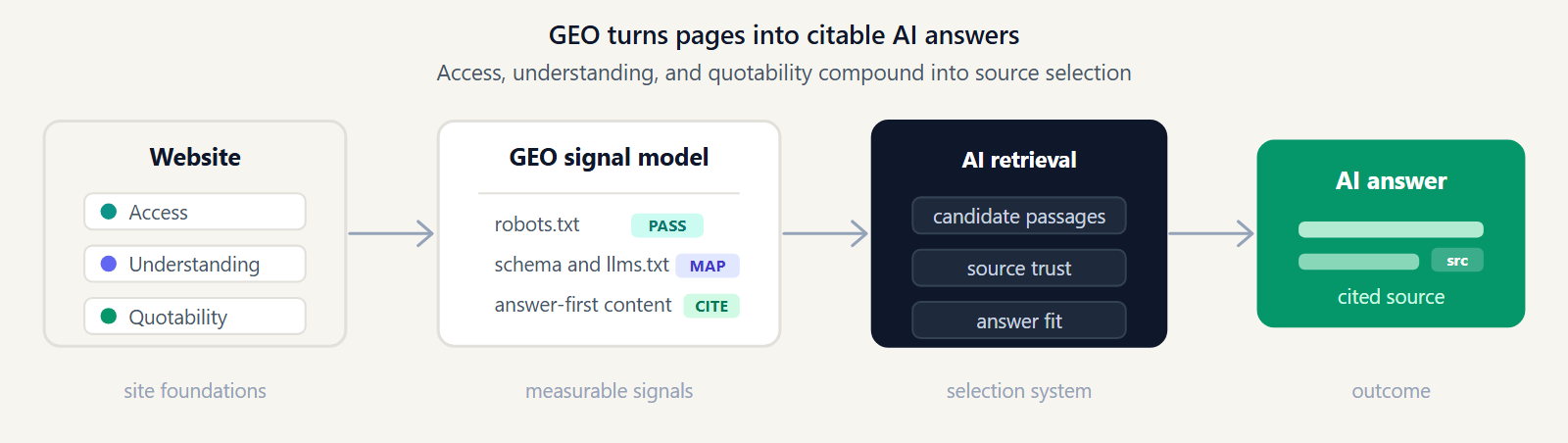
In practice GEO touches three layers:
- Access — can AI crawlers fetch your pages at all? This is
robots.txt, AI-bot permissions, and clean HTML. - Understanding — can a model identify what your site is, what it covers, and who you are? This is schema
JSON-LD, entity clarity, and orientation files likellms.txt. - Quotability — is the content written so a passage can be lifted cleanly into an answer? This is answer-first writing, clear structure, and factual density.

For a deeper introduction to the discipline and where it fits in a modern strategy, see our AI SEO overview.
Why GEO matters now
A growing share of informational, comparison, and how-to queries are now answered directly by AI assistants instead of a search results page. When a model writes the answer, the user often never visits the ranked list at all. If your content is invisible to the systems that assemble those answers, you are absent from a channel that did not exist a few years ago.
This does not mean classic search is going away. It means the surface where people encounter your expertise is fragmenting. Being cited in an AI answer can drive qualified referral traffic and, more importantly, shapes how a model describes your brand and category. The earlier you make your site legible to these engines, the more of that surface you can occupy before competitors do.
There is also a defensive reason. AI engines build a model of your brand from whatever they can read — your site, third-party mentions, and structured data. If you leave that ambiguous, the model fills the gaps itself, sometimes incorrectly. GEO is partly about controlling the narrative the machine learns.
GEO vs SEO
The short version: SEO optimizes for ranking links; GEO optimizes for being cited inside a synthesized answer. They share crawlability, indexable HTML, canonical URLs, domain authority, and structured data as a common foundation. What changes is the target metric — there is no "position one" inside a paragraph, so you optimize for quotability and source trust instead of click-through rate.
A few shifts summarize the difference:
- Quotability over keyword density — write passages a model can lift cleanly.
- Entity clarity over anchor text — make it unmistakable what a brand is and what category it belongs to.
- Source trust over CTR — engines assess accuracy, authority, and freshness, not click behavior.
- Explicit AI crawler decisions —
robots.txtnow has to account for bots likeGPTBotandPerplexityBot.
This is a summary. For the full breakdown — what stays the same, what changes, and a practical priority order — read the dedicated guide: GEO vs SEO: what changes for AI answer engines.
How AI answer engines discover and cite sources
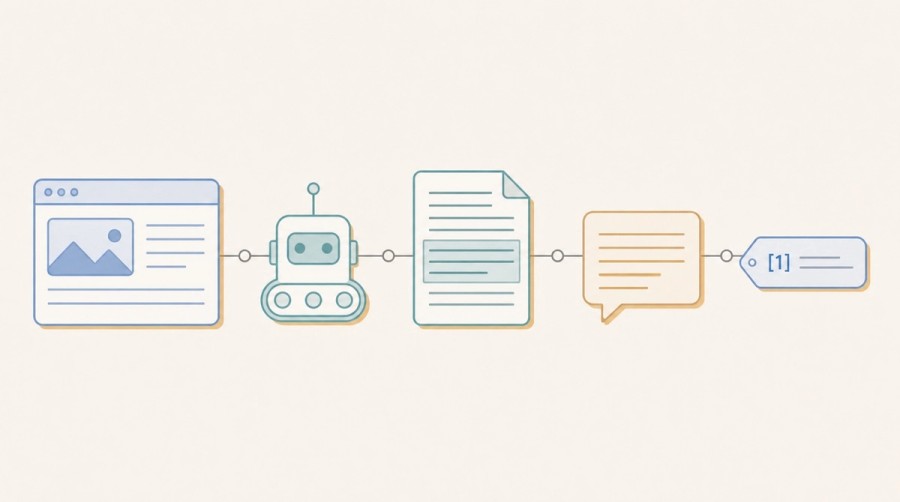
AI answer engines do not all work the same way, but most follow a similar pipeline. Understanding it tells you where to intervene.
- Crawling and training. Bots like
GPTBotandClaudeBotfetch public pages. Some of that content may inform training; yourrobots.txtcontrols whether they are allowed in. - Live retrieval. For current information, engines query a search index or fetch pages at answer time — this is retrieval-augmented generation (RAG). Search-oriented bots such as
OAI-SearchBotandPerplexityBotmatter most here. - Ranking and selection. The engine scores candidate passages for relevance, authority, and freshness, then selects a few to ground the answer in.
- Synthesis and citation. The model writes a unified answer and attributes the sources it leaned on, usually as inline links or footnotes.
The practical implication: a citation requires you to pass every stage. If a bot is blocked, you never enter the pipeline. If your page is rendered only by JavaScript, a basic fetch may see nothing. If your content is verbose and hard to extract, the selection step skips it even when it is relevant. GEO removes these barriers one stage at a time.
The core GEO signals
GeoReady scores a site across nine signal categories. They map directly to the access, understanding, and quotability layers above, and they are a useful mental model whether or not you use the tool.
- Robots.txt and AI crawler access — whether bots like
GPTBot,OAI-SearchBot,ClaudeBot, andPerplexityBotare allowed, and whether your file is even reachable. - llms.txt — an orientation file at your domain root that lists key pages and describes the site for LLM tools that read it directly. Not a confirmed ranking factor, but a low-cost way to make important URLs explicit.
- Schema JSON-LD — structured data such as
Organization,WebSite,Article, andFAQPagethat helps engines disambiguate entities and extract facts. - Meta tags — accurate titles, descriptions, canonical tags, and Open Graph data that summarize each page consistently.
- Content quality — clear headings, answer-first paragraphs, lists, factual density, and front-loaded conclusions that are easy to quote.
- Technical signals — declared language, an RSS or Atom feed, and visible freshness signals that help engines judge recency.
- AI discovery — well-known files and machine-readable summaries, such as
/.well-known/ai.txtand JSON summary or FAQ endpoints, that describe what your site offers. - Brand and entity — consistent naming, knowledge-graph readiness, clear about and contact information, and topic authority that lets a model place you correctly.
No single signal guarantees anything on its own. They compound: clean access lets the bot in, strong understanding lets it place you, and quotable content lets it cite you.

Technical GEO checklist
Start with the access and understanding layers — they are the fixes most likely to be silently blocking you.
- Audit
robots.txtfor unintended AI blocks. If you are disallowingGPTBotorPerplexityBot, make that a deliberate choice — blocking retrieval bots also blocks the path to citation. - Serve content in server-rendered HTML. If a passage only appears after client-side JavaScript runs, assume a basic crawler will not see it.
- Set a single canonical URL per page and keep trailing slashes consistent, so retrieval systems do not split trust across duplicates.
- Add core schema
JSON-LD—OrganizationandWebSiteat minimum, plusArticleorFAQPagewhere they apply. The parser should support both direct@typeand@graphformats. - Publish an
llms.txtat your domain root pointing to your most important content. See our llms.txt implementation guide for the format. - Expose freshness — visible dates, a working feed, and an accurate
dateModifiedin the schema. - Confirm fast, correct responses — proper status codes, no soft 404s, and reasonable load times so bots do not give up.
Content GEO checklist
Once a model can reach and understand your site, the question becomes whether your writing is quotable. Optimize each important page for direct extraction.
- Lead with the answer. The first paragraph of a page should state what the thing is or what you do, in one clear sentence, before any context. This is the passage a model is most likely to lift.
- Write self-contained sentences. A fact should make sense out of context, without relying on the sentence before it. Models extract fragments, not whole pages.
- Use clear heading hierarchy. One
h1, then descriptiveh2andh3headings that match how people phrase questions. - Prefer structure over prose for definitions, steps, and comparisons. Lists and tables are easier to parse and quote than dense paragraphs.
- Add factual density — concrete numbers, dates, named entities, and specifics. Vague marketing copy is rarely citable.
- Answer real questions with a short, dedicated FAQ section, mirrored in
FAQPageschema, so engines can pair a question with a clean answer. - Keep entity language consistent — same brand name, product names, and category wording on every page, so the model builds one coherent entity instead of several fuzzy ones.
For an engine-by-engine view of what each system tends to favor, see how to appear in ChatGPT and Perplexity sources.
How to measure GEO readiness
GEO is hard to measure with a single number because the outcome — a citation — happens inside a system you do not control. The honest approach is to measure readiness directly and treat downstream citations as a lagging, directional signal.
- Score your readiness signals. Run a baseline audit across all nine signal categories and record the result. This is fully within reach and improves immediately when you fix issues.
- Track changes over time. A single snapshot tells you where you are; repeated audits tell you whether a change actually moved a signal. Models and your own site both shift, so monitoring beats one-off checks.
- Watch for AI referral traffic. Some analytics setups can surface visits referred from AI assistants. Treat any AI referral observed as encouraging evidence, not proof of a citation — attribution here is imperfect.
- Spot-check answers manually. Ask the engines questions where you would expect to be a relevant source, and note whether and how you appear. This is qualitative, but it grounds the numbers. For a structured way to do this, see how to check whether ChatGPT and Perplexity cite your brand.
For a single, consolidated pass over every signal, work through the AI visibility checklist. If you want to see exactly how each category is weighted before you run an audit, the scoring methodology documents the points behind every signal. Nobody can guarantee a model will cite you — citation behavior is probabilistic and changes with every retraining — but you can make your site as easy to cite as possible and verify that with data.
Further reading
- GEO vs SEO: what changes for AI answer engines — the detailed comparison.
- How to appear in ChatGPT and Perplexity sources — engine-specific tactics.
- AI visibility checklist — every signal in one place.
- How to improve AI visibility — a step-by-step plan once you have your baseline score.
- llms.txt for WordPress and AI visibility — practical implementation.
- Best GEO tools — how to choose a generative engine optimization tool.
- AI SEO overview — where GEO fits in a wider strategy.
- The signals behind these guides: our research foundation.
- Is AI search traffic actually growing?
- Prompt injection attacks on AI crawlers
Apply this guide
Run an AI SEO audit before you change pages.
Use the audit to find which signal is holding the site back: crawler access, schema, llms.txt, content clarity, AI discovery, or entity strength.
- Best for pages that need a technical and content baseline.
- Next metric: AI readiness score plus the weakest signal category.
Frequently asked questions
What does GEO mean in AI search?
GEO stands for Generative Engine Optimization: structuring a website so AI answer engines like ChatGPT, Perplexity, Claude, and Gemini can more easily crawl, understand, and evaluate its content. It is not geographic or local SEO.
Is GEO different from SEO?
GEO and SEO share the same technical foundations — crawlability, indexable HTML, structured data, and domain authority. The difference is the target. SEO optimizes for a ranked list of links a person clicks. GEO optimizes for being retrieved, summarized, and cited inside a single AI-generated answer. You build GEO on top of SEO, not instead of it.
Does GEO replace SEO?
No. Classic search is still the dominant interface for most queries, and ranking well in traditional search correlates with appearing in the retrieval sets that AI engines draw from. GEO extends your work into AI answer surfaces; it does not replace transactional, local, or navigational search.
Is llms.txt a ranking factor?
There is no confirmed evidence that llms.txt influences rankings or guarantees citations. It is an emerging orientation file that lists your important pages and describes what your site is about, in plain text that LLM tools can read directly. Treat it as a low-cost hint, not a guarantee.
Can a tool guarantee that ChatGPT or Perplexity will cite my site?
No. Citation behavior is probabilistic and changes every time a model is retrained or its retrieval index updates. No tool or technique can guarantee a specific engine will cite you. What you can do is remove the technical and content barriers that prevent a model from finding, understanding, and quoting your pages.
How do I know if my site is GEO-ready?
Run an audit that scores the signals AI engines rely on: robots.txt and AI crawler access, llms.txt, schema JSON-LD, meta tags, content quality, technical signals, AI discovery files, and brand and entity clarity. A baseline score tells you where you stand; tracking it over time tells you whether your changes worked.
How long does GEO take to show results?
Technical fixes — crawler access, schema, llms.txt — can be detected by AI tooling within days. Changes in how often a model cites you are slower and harder to attribute, because they depend on retraining cycles and retrieval indexes you do not control. Measure readiness signals continuously and treat any AI referral observed in your analytics as a directional signal, not proof.
Get the monthly State of GEO report
AI search readiness benchmarks, adoption stats, and the actions that move the needle — delivered monthly. No spam.
By submitting, you agree to receive the monthly GeoReady newsletter: benchmark data from the State of GEO dataset, practical GEO guidance, and product updates. You can unsubscribe anytime. See our Privacy Policy.