State of GEO: June 2026
AI Search Readiness Across 288 Domains
Every June, GeoReady publishes its benchmark of AI search readiness across sites audited with the open-source GEO Optimizer engine. This is the first full edition: 288 unique domains, scored across 8 categories, 100 points, and a single consistent rubric. The numbers below are the baseline to beat — and the map of where almost every website is still leaving points on the table.
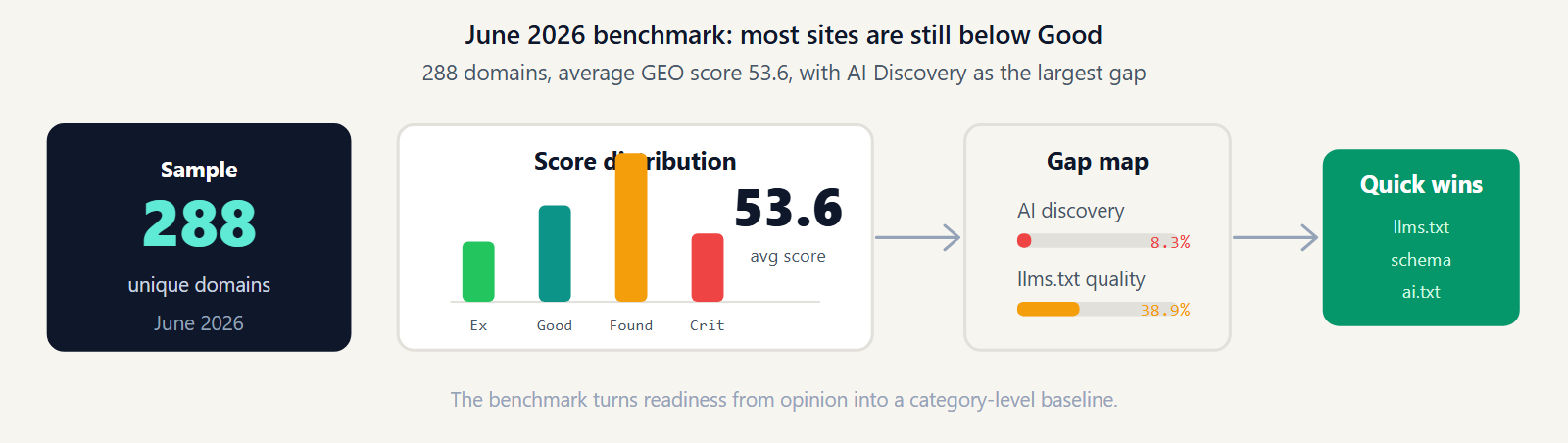
Executive summary — June 2026
n = 288 · 10–30 Jun 202653.6
avg GEO score / 100
288
unique domains
58.3%
have llms.txt
79.2%
Foundation or Critical
- 84% of audited sites are in the Foundation or Critical band — most can be reached by AI but cannot be cited with confidence.
- AI Discovery is the worst-performing category at 8.3% efficiency — the single biggest opportunity in June 2026.
- Having an llms.txt is not enough: only 27.8% of domains have a full, structured file.
- .ai domains lead with a 90% llms.txt adoption rate and a 59.7 average score — the highest of any TLD.
source: benchmark_audit_events · GET /api/public/benchmark
Score distribution: 84% below the Good threshold
The average GEO score across 288 unique domains is 53.6 out of 100. The median is 57, with the bottom quarter of sites scoring at or below 44 and the top quarter at or above 66. The highest score in the dataset is 90; the lowest is 7.
The band breakdown is the clearest way to read the data:
| Band | Score range | Domains | Share | What it means |
|---|---|---|---|---|
| Excellent | 86–100 | 4 | 1.4% | All 8 categories well covered. Citable by AI with confidence. |
| Good | 68–85 | 56 | 19.4% | Strong fundamentals. Minor gaps in entity signals or AI discovery. |
| Foundation | 36–67 | 186 | 64.6% | Reachable by AI but thin on structure, entity, and discovery signals. |
| Critical | 0–35 | 42 | 14.6% | Significant barriers — blocked crawlers, missing schema, no AI signals. |
The practical reading: four in five audited sites cannot be described, cited, or recommended by an AI engine with confidence. They can be crawled — most pass the robots.txt check — but they lack the structured signals that let models anchor facts to a specific brand or page. Being reachable is not the same as being citable.
Category breakdown: where every site is winning and losing
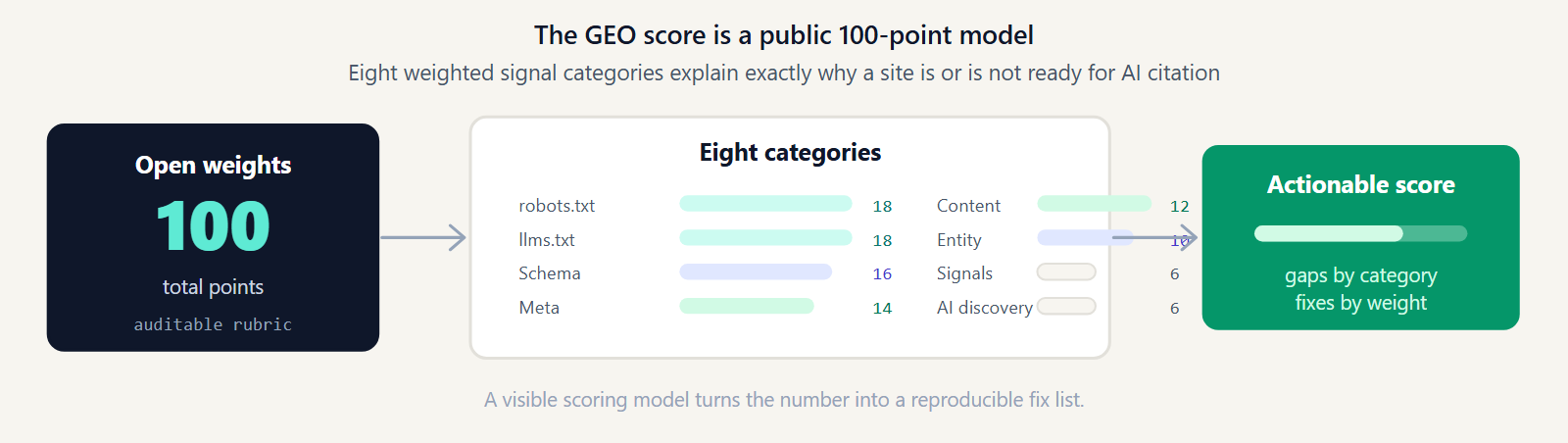
The GEO rubric scores eight categories. Each has a different maximum. The table below shows the June 2026 average for each, what the maximum is, and the efficiency percentage — how much of the available points the average site is capturing.
| Category | Avg score | Max | Efficiency | |
|---|---|---|---|---|
| Meta tags | 12.4 | 14 | 88.6% | |
| Content quality | 9.6 | 12 | 80% | |
| Robots & crawler access | 13.6 | 18 | 75.6% | |
| Technical signals | 3.7 | 6 | 61.7% | |
| LLMs.txt | 7 | 18 | 38.9% | |
| Schema markup | 6.1 | 16 | 38.1% | |
| Brand & entity | 3.8 | 10 | 38% | |
| AI discovery | 0.5 | 6 | 8.3% |
Three categories form a strong foundation. Meta tags lead at 88.6% efficiency — title tags, descriptions, and canonical URLs are well understood and broadly implemented. Content quality follows at 80%, driven by the 77.1% of sites that lead pages with a direct, parseable answer. Robots and crawler access scores 75.6%: most sites allow the major AI bots, with an average of 23.3 bots explicitly permitted.
Three categories cluster at the bottom. Schema markup at 38.1%, LLMs.txt at 38.9%, and Brand & entity at 38.0% all score below 40% of their potential. But the outlier is AI Discovery at just 8.3% — an average of 0.5 points out of 6. In June 2026, AI discovery files are still a concept that almost no one has acted on.
Adoption rates: the machine-readability stack
n = 288 · 10–30 Jun 2026
The GEO rubric checks specific technical signals beyond category scores. These adoption rates show where the default behavior of the web sits in June 2026.
Near-universal — language is the most implemented signal.
Strong baseline. 18.4% of sites still risk duplicate-content confusion.
Slightly below canonical — a gap in basic content structure.
Surprisingly high. Most sites open key pages with a direct statement.
Present but shallow — average schema score is only 38.1% of max.
Majority have one — but see below.
Half of sites. Brand entity clarity starts here.
Slightly above Organization but often missing sitelinks search.
Only 27.8% have a complete file — 30% of llms.txt adopters publish a minimal stub.
/.well-known/ai.txt and similar. The biggest untapped category.
Rare — despite FAQ content being present on many pages.
Low even as content — Q&A structure is underused.
The llms.txt data reveals a pattern common in early-adoption cycles: presence is not quality. 58.3% of audited sites have an llms.txt file — a clear majority. But only 27.8% have a full, structured file with meaningful sections and links. The remaining 30% of adopters publish a minimal file: sometimes a single line, sometimes a stub with no URLs. A stub llms.txt is better than nothing, but it provides almost no orientation value to an AI tool trying to understand a site's important content.
llms.txt correlation
n = 288 · 10–30 Jun 2026+24 pts
Sites with llms.txt average 66/100. Sites without average 42/100. Publishing an llms.txt is the single signal most correlated with overall GEO score.
Schema markup correlation
n = 288 · 10–30 Jun 2026+29 pts
Sites with valid JSON-LD average 65/100. Sites without average 36/100. Organization and WebSite schema drive the biggest share of this gap.
The biggest gap: AI Discovery at 8.3% efficiency
Every category in the GEO rubric has a gap. But AI Discovery is in a different tier. The average score is 0.5 points out of a maximum of 6 — an 8.3% capture rate. Only 16% of audited sites expose any AI discovery endpoint.
AI discovery files — like /.well-known/ai.txt and the signals inside a well-structured llms.txt — are designed to make a site explicitly machine-navigable. They go beyond allowing crawlers: they describe the site's purpose, its most important content, and the context an AI needs to answer questions about it with specificity rather than generality.
The gap exists because these standards are new and publishing them requires deliberate action — nothing in a default CMS install or hosting setup creates them automatically. That makes it one of the rarest signals in June 2026, and one of the easiest to capture simply by doing what almost nobody has done yet.
Opportunity sizing
A site that publishes a complete /.well-known/ai.txt, a structured llms.txt, and correct Organization + WebSite schema can move from a Foundation score to a Good score without touching a single line of content. That is roughly 15–25 points of recoverable GEO score from three files, none of which require backend changes.
By TLD: who is leading AI search readiness
Breaking the dataset by top-level domain reveals a clear pattern: AI-native extensions lead, and the gap is structural, not random. Sites on .ai extensions are AI-first companies that already understand why machine-readability matters. Sites on .cn are the furthest behind, separated by more than 36 points from the .ai average.
| TLD | Domains | Avg score | llms.txt | Schema |
|---|---|---|---|---|
| .ai | 10 | 59.7 | 90% | 80% |
| .dev | 3 | 57.3 | 66.7% | 66.7% |
| .com | 163 | 55.2 | 63.8% | 71.8% |
| .app | 7 | 54.9 | 71.4% | 57.1% |
| .it | 21 | 54.3 | 33.3% | 81% |
| .io | 8 | 48.9 | 62.5% | 62.5% |
| .org | 9 | 48.3 | 44.4% | 77.8% |
| .cn | 9 | 23.2 | 33.3% | 22.2% |
The .ai finding is not just about score — it is about intent. 90% of .ai domains have an llms.txt, the highest adoption rate of any TLD in this dataset. That is almost certainly not a coincidence: companies that build products for the AI market understand that AI tools need to be able to read them.
Italian sites (.it) present an interesting counterpoint: their schema adoption is 81%, among the highest of any TLD, yet llms.txt adoption sits at just 33.3%. Italian web teams have embraced structured data — a mature SEO practice — but have not yet made the jump to AI-specific signals. This is a pattern that appears across many markets: traditional technical SEO skills do not automatically translate to AI readiness.
.org sites follow a similar pattern: 77.8% schema adoption but only 44.4% llms.txt. Non-profit and institutional organizations have strong technical foundations but are slower to adopt emerging AI signals. .cn sites are the outlier in the other direction: low on both fronts, with 22.2% schema adoption and 33.3% llms.txt — the lowest scores in the dataset.
What June 2026 tells us about AI search readiness
Three signals have become the baseline that most competent web teams now hit: a canonical URL (81.6%), a correct H1 (81.3%), and a lang attribute (93.4%). These are hygiene, not differentiation. They are the floor, not the ceiling.
The next tier — the one that separates Foundation from Good — is where most June 2026 sites stall. Getting from 53.6 to 70 requires three things that are known but not yet widespread: a complete llms.txt (not just a stub), Organization and WebSite schema with consistent brand naming, and at least one AI discovery endpoint. Together, these three moves are worth 15–25 points for most Foundation sites.
The deeper story in the data is that AI search readiness has a skills-transfer problem. Teams that are strong on traditional SEO — meta tags, canonical, schema basics — are not automatically strong on AI signals. The skills overlap, but AI readiness requires a different vocabulary: machine navigation rather than search engine optimization, entity disambiguation rather than keyword targeting, AI discovery rather than sitemap submission. The teams that already understand AI (the .ai domain cohort) have made the leap instinctively. Most others have not yet.
The good news: nothing in the gap is architecturally difficult. The actions that move a site from Foundation to Good — publish a complete llms.txt, add the right schema types, expose AI discovery files — do not require a redesign, a backend migration, or a content overhaul. They are publishing decisions. They require knowing what to publish, not building anything new.
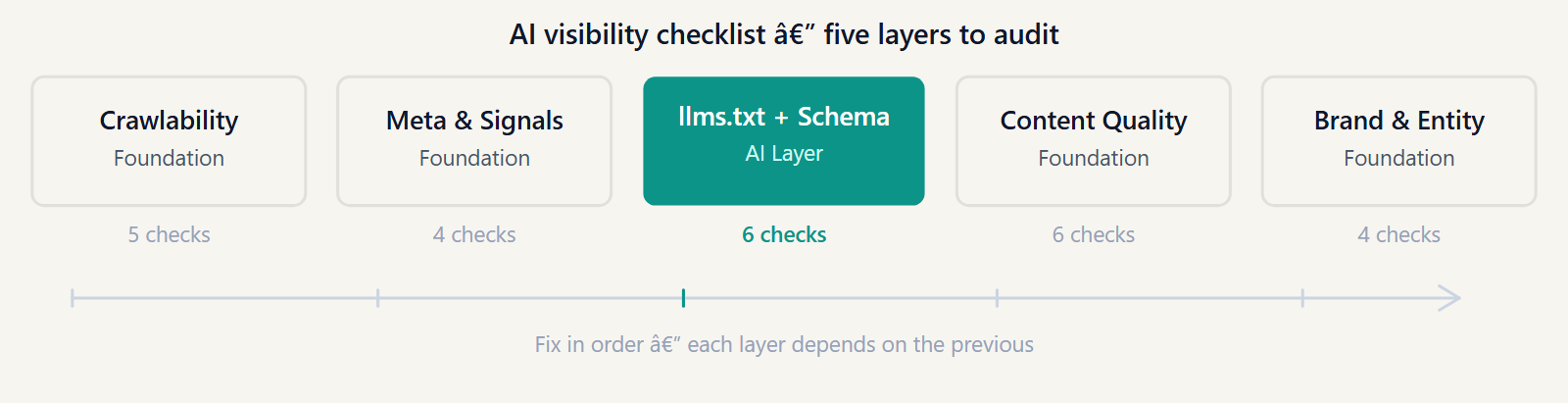
The June 2026 quick-win checklist
Based on where audited sites lose the most points, these are the highest-leverage actions in June 2026, ordered by expected point recovery per hour of work:
- Publish a full llms.txt (not a stub). Include at minimum: a brief site description, sections for your most important pages, and URLs to your docs, blog, and product pages. Use the free llms.txt generator to build a starter in under 5 minutes.
- Add Organization and WebSite JSON-LD. Only 51% and 52.4% of sites have these respectively, despite them being among the highest-value schema types for entity recognition. Include
name,url,logo,sameAs, anddescriptionat minimum. - Publish a
/.well-known/ai.txt. Only 16% of sites do this. It is a single file with a handful of lines — but it is the signal that places a site in the top 16% of AI discovery readiness immediately. - Audit your robots.txt for accidental AI bot blocks. The average site allows 23.3 AI bots but blocks 0.5. Confirm that
GPTBot,ClaudeBot,PerplexityBot, andGoogleOtherare either explicitly allowed or not listed (default allow). - Add FAQ schema where FAQ content already exists. Only 13.2% of sites have FAQ schema, but 13.2% have FAQ content. These should be the same number. Every page with a Q&A section that lacks FAQ JSON-LD is a missed citation opportunity.
- Re-audit after each change. The GEO rubric rewards compound improvements: each signal reinforces the others. A site with llms.txt + Organization schema + canonical URL is not just the sum of three parts — it is an entity that AI models can triangulate across multiple signals.
See where your site stands against the June 2026 benchmark
The average score in June 2026 is 53.6. Run a free audit to see your GEO score across all eight categories, identify which band you are in, and get the specific actions that recover the most points first.
Methodology
This report covers 288 unique domains audited by GeoReady between 10 June and 30 June 2026. When a domain was audited multiple times in the period, only the most recent audit is included — this prevents repeat users from inflating the cohort size and ensures each domain appears once at its best-known state.
- Engine version: GEO Optimizer 4.12.x, the open-source 100-point, 8-category rubric. Source available on GitHub.
- Audited sample: Sites that chose to audit with GeoReady — not a random sample of the web. The cohort skews toward teams already interested in AI visibility, so these figures likely overestimate average readiness across all websites.
- Anonymized: Domain names are stored as salted HMAC-SHA256 hashes in the benchmark dataset. No individual domain is identifiable in the public figures.
- Monitoring audits excluded: Only user-initiated audits (web, API, CLI) are included. Scheduled monitoring re-checks are excluded to avoid inflating the cohort with the same domains audited repeatedly.
- Consistent rubric: Every domain is scored with the same engine and the same weights. Category maxima: Robots 18, LLMs 18, Schema 16, Meta 14, Content 12, Brand & Entity 10, Signals 6, AI Discovery 6.
The underlying benchmark dataset is the benchmark_audit_events table in the GeoReady production database. The public API endpoint (GET /api/public/benchmark) returns aggregated figures only — no per-domain data is ever exposed.
Get the July 2026 report when it drops
The State of GEO publishes monthly. Each edition adds new domains, tracks score trends over time, and goes deeper on the categories that matter most. Subscribe to get it the day it ships.
By submitting, you agree to receive the monthly GeoReady newsletter: benchmark data from the State of GEO dataset, practical GEO guidance, and product updates. You can unsubscribe anytime. See our Privacy Policy.
Frequently asked questions
What is the average GEO score in June 2026?
The average GEO score across 288 unique domains audited by GeoReady in June 2026 is 53.6 out of 100. The median is 57, meaning half of audited sites score below that threshold. Only 20.8% of sites reach the "Good" band (68–85) or above.
How many sites have an llms.txt file?
58.3% of the 288 domains audited in June 2026 have an llms.txt file. However, only 27.8% have a full, well-structured llms.txt — the majority publish a minimal file that provides little orientation value to AI tools.
What is the biggest AI search readiness gap in June 2026?
AI Discovery is the single largest gap: only 16% of audited sites expose any AI discovery endpoint (such as /.well-known/ai.txt or similar), and the average AI Discovery score is just 0.5 out of 6 points — an 8.3% efficiency rate. This is the category where the most points are left on the table.
Which type of website has the best GEO score?
.ai domains lead with an average GEO score of 59.7 and a 90% llms.txt adoption rate. This reflects a self-selection effect: companies that build on .ai extensions are typically AI-native or AI-focused, and they already understand why machine-readability matters for AI search visibility.
What does a GEO score of 53.6 mean?
A score of 53.6 places a site in the "Foundation" band (36–67), meaning it has covered some AI search basics — crawlability and meta tags — but is missing structured data depth, llms.txt completeness, brand entity signals, and AI discovery files. It can be found and parsed by AI, but not cited with confidence.
Is schema markup adoption high?
70.1% of audited sites have some schema markup, but the average schema score is only 6.1 out of a maximum 16 points — 38.1% efficiency. Most sites implement a minimal schema type and leave the rest. Only 51% have Organization schema and 52.4% have WebSite schema — two of the most impactful types for entity recognition.
How does this benchmark compare to the whole web?
This is a benchmark of sites that chose to audit with GeoReady — not a random sample of the entire web. The cohort skews toward teams already curious about AI visibility, which means these scores likely overestimate average readiness. Real-world averages across all websites are almost certainly lower.
Beat the June 2026 average of 53.6
Run a free AI SEO audit to get your full GEO score, see which of the 8 categories is costing you the most points, and get a ranked action list. No account required for the baseline snapshot.
New to AI search readiness?What is AI SEO ·What is llms.txt ·Free llms.txt generator