How Perplexity Chooses Sources: What We Know So Far
Perplexity cites multiple sources per answer, but not randomly. Here's what's observable about how it selects and weighs them.
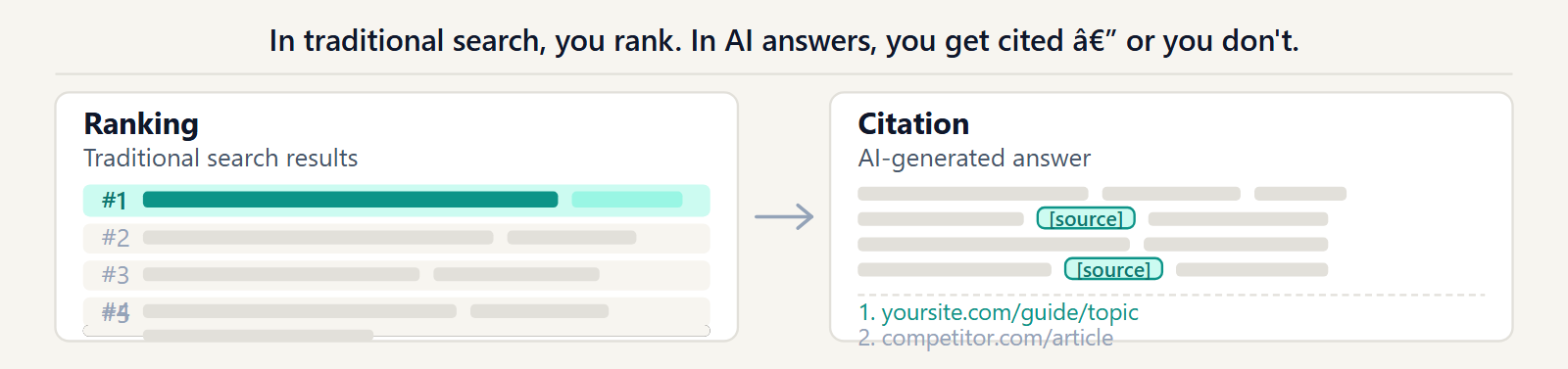
Perplexity doesn't publish its ranking algorithm, but a few patterns are consistent enough across repeated queries to be useful guidance rather than guesswork.
It favors direct, self-contained answers

Pages that state a clear answer near the top — a definition, a number, a direct recommendation — get quoted more often than pages that build up to a conclusion after several paragraphs of context.
It spreads citations across multiple domains

Answers rarely cite just one source. Perplexity tends to pull from several independent domains per answer, which means being the only voice saying something matters less than being one of several credible sources saying it consistently.
Freshness matters more for time-sensitive queries

For anything with a "in 2026" or "latest" framing, recently updated pages are favored. For stable reference topics, older well-established pages still get cited without penalty.
Structure helps it extract the right passage
Clear headings, short paragraphs, and lists make it easier for any retrieval system — Perplexity included — to isolate the exact passage that answers the query, rather than citing a vague summary of the whole page.
Entity clarity still matters
Consistent naming and clear entity authority signals still help Perplexity confirm who's speaking. For a broader practical playbook across both ChatGPT and Perplexity, see our guide to appearing in ChatGPT and Perplexity answers.
Further reading
Apply this guide
Check whether Perplexity-style answers cite your domain.
Use the citation checker path when the risk is that answer engines quote competitors, review sites, or third-party sources instead of your own pages.
- Best for source-backed answers where the cited URL matters.
- Next metric: direct citations, competitor citations, and missing citations.
Frequently asked questions
Has Perplexity published an official ranking algorithm for sources?
No. What follows are patterns observable from how it behaves in practice, not a confirmed official specification — treat it as directional guidance, not a guarantee.
Does Perplexity prefer recent content over older, more established pages?
Freshness appears to be one factor among several, particularly for time-sensitive queries. Well-established, clearly authoritative pages still get cited even when older, especially for stable, non-time-sensitive topics.
Get the monthly State of GEO report
AI search readiness benchmarks, adoption stats, and the actions that move the needle — delivered monthly. No spam.
By submitting, you agree to receive the monthly GeoReady newsletter: benchmark data from the State of GEO dataset, practical GEO guidance, and product updates. You can unsubscribe anytime. See our Privacy Policy.