Does the GEO score predict whether Perplexity cites a page? A pre-registered test
We tested, with a plan fixed in advance, whether the GEO score predicts Perplexity citations on 341 pages. No effect was detected. Numbers and limits inside.
What we tested
The GEO score measures structural readiness: whether crawlers can reach a page, whether it can be read, quoted and attributed. It does not measure whether an AI system cites you today. We wanted to know whether, on real pages, a higher score goes with a higher chance of being cited.
What we did
- Sample. 341 pages, one per site, from the public Tranco popularity list, drawn across ten rank bands. We kept sites that were reachable, in English and with a sitemap, and chose one informational page per site. Pages whose headline contained the site's brand name were left out.
- Score. Each page was audited with the open-source GEO Optimizer CLI, version 4.19.3, rubric v2.
- Question. For each page we built two questions from its own headline, with fixed wording: "What are the most reliable sources on: [headline]" and "Explain this topic and cite your sources: [headline]". Each was sent once to Perplexity Sonar through its API, on 17 October 2026.
- Outcome. Whether the page's domain appeared among the sources Perplexity returned.
- Analysis, fixed in advance. A logistic regression of the outcome on the score, controlling for the site's popularity rank and the page's length. The plan was written before the full run; its SHA-256 hash is 441fcbb422964fdf2bf2b63eb02181ccbea9e7c5590d3e770399d567cd373ff8.
What we found
- Domain cited, first question: 42% of pages. Second question: 45%.
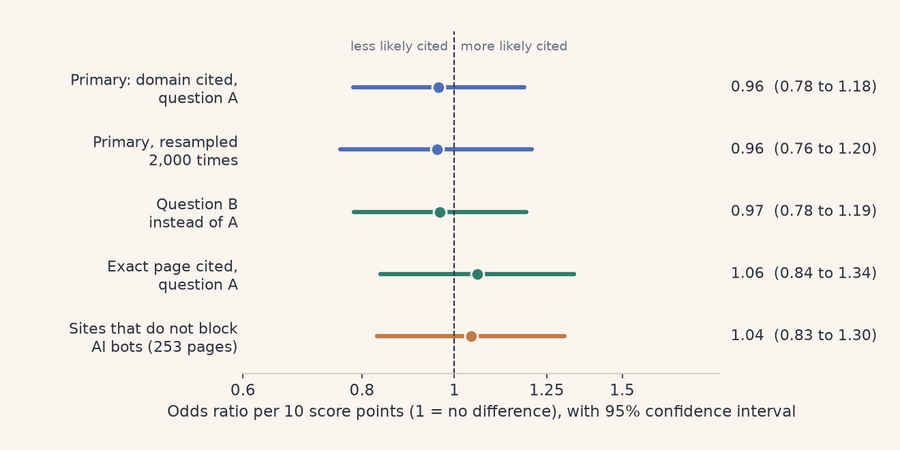
- Change in the odds of being cited per 10 score points: 0.96 (95% confidence interval 0.78 to 1.18).
- The same after resampling the data 2,000 times: 0.96 (0.76 to 1.20).
- The same, only for sites that do not block AI bots (253 pages): 1.04 (0.83 to 1.30).
- Correlation between score and being cited, controlling for popularity: 0.03.
- Eight of the nine score categories, one at a time (AI discovery had no variation in the sample): none significant.
An odds ratio of 1 means no difference. Ours is close to 1 and its interval includes 1. The interval excludes an increase of more than about 18% in the odds per 10 score points. It does not exclude a small effect.
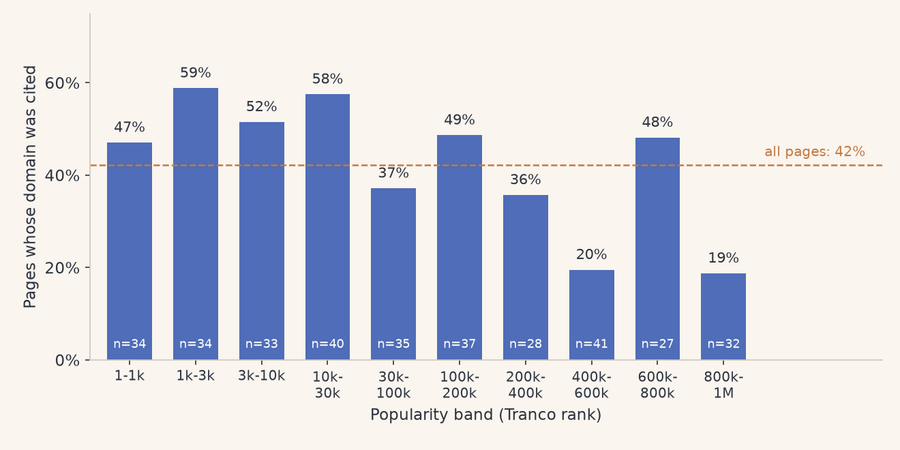
Popularity matters, which is why the analysis controls for it. The share of pages whose domain was cited was 54% in the four most popular bands and 29% in the four least popular ones (141 and 128 pages), although it does not fall steadily from band to band.
What this does and does not show
- It does not show that structure is irrelevant. It shows that this score did not predict citation in this test.
- It does not cover ChatGPT, Gemini, Claude or Google's AI features. We tested one engine on one date with one model version, and engines change.
- The questions were built from each page's own headline. The test therefore measures whether a page is cited when the question names its own topic, not how it ranks against every competing source.
- The sample leans toward sites that are reachable, written in English and publish a sitemap. Sites that block our user agent are under-represented.
- The data are observational. We make no causal claim.
What we are doing about it
We are not changing the scoring weights because of this result. The score remains a measure of structural readiness, not a prediction of citations.
Data
The pre-registered analysis plan and an anonymised results table (one row per page: rank band, score, the category scores, page length and the outcomes; no domain, no address, no headline) are published in the GEO Optimizer repository so that the figures above can be checked. The audit and API-call scripts are not published.
Sources: the Tranco list at tranco-list.eu (public popularity ranking) and the Perplexity Sonar API.
Apply this guide
Run an AI SEO audit before you change pages.
Use the audit to find which signal is holding the site back: crawler access, schema, llms.txt, content clarity, AI discovery, or entity strength.
- Best for pages that need a technical and content baseline.
- Next metric: AI readiness score plus the weakest signal category.
Frequently asked questions
Does the GEO score predict whether Perplexity cites a page?
Not in our test. On 341 pages, the odds of being cited changed by a factor of 0.96 per 10 score points (95% confidence interval 0.78 to 1.18), so we could not detect an effect and a large one is ruled out. It is one engine, one date and one test design.
Does this show that page structure does not matter?
No. It shows that this score did not predict citation in this test. The test covers one engine on one date, and the questions named each page's own topic, so it does not measure how pages rank against all competing sources.
Get the monthly State of GEO report
AI search readiness benchmarks, adoption stats, and the actions that move the needle — delivered monthly. No spam.
By submitting, you agree to receive the monthly GeoReady newsletter: benchmark data from the State of GEO dataset, practical GEO guidance, and product updates. You can unsubscribe anytime. See our Privacy Policy.