How to Optimize for Google AI Overviews in 2026
Google AI Overviews sit above blue links for most informational searches. How sources get selected and the concrete steps to get cited. Audit free.
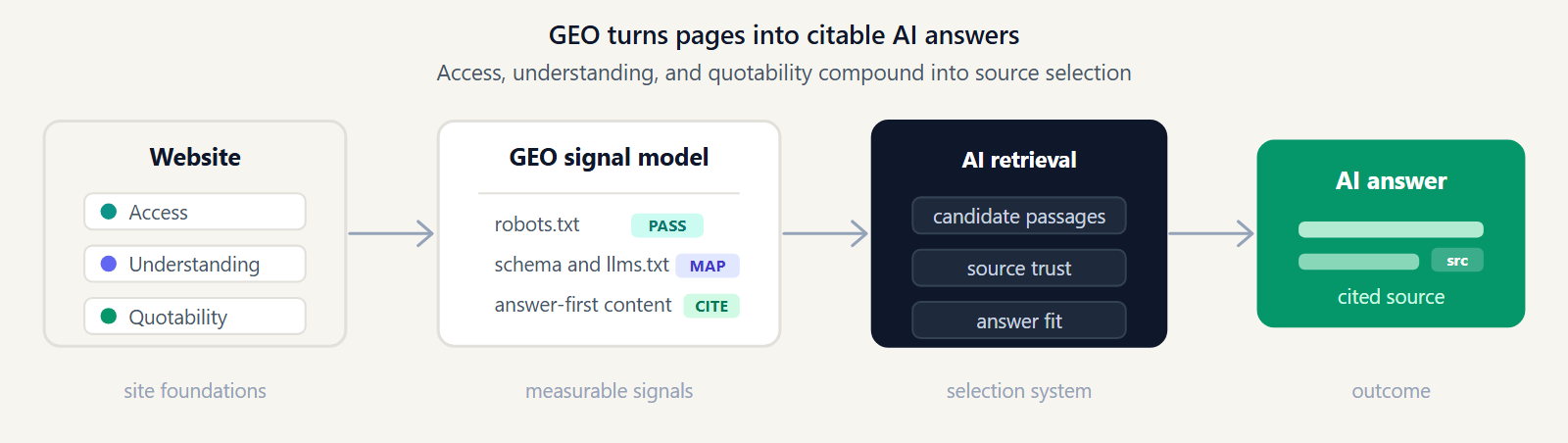
Google AI Overviews now appear above the ten blue links for a large share of informational searches in the US, and for many of those queries, the Overview is the only thing a user reads before deciding whether to click through at all. Ranking third in the classic organic results means very little if the Overview above it never mentions you. This guide walks through how Overviews actually select and synthesize sources, and the concrete steps to get cited in them.
What Google AI Overviews actually are
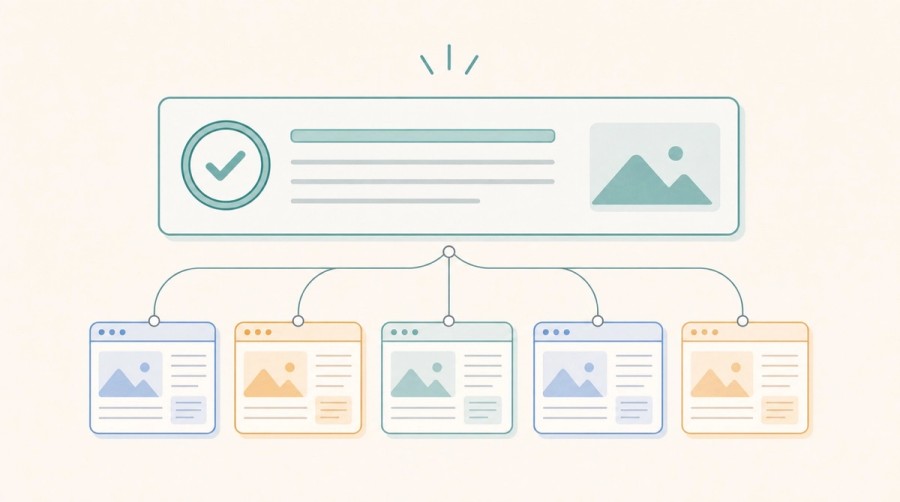
An AI Overview is a synthesized answer generated live for a search query, powered by Google's Gemini models, that draws on multiple web pages at once and presents a blended answer with clickable citations back to its sources. Unlike a static answer box, it's generated per-query rather than pulled from a single pre-written snippet, and it can change from one search to the next as Google's models and index shift.
AI Overviews vs. Featured Snippets
A Featured Snippet is a single quote pulled from a single page, chosen because that one page answered the query most directly. An AI Overview is a synthesis across several pages, meaning a page can contribute to the answer without being the only source, and without needing to be the single "best" match for the whole query. That changes the target: instead of writing to win one snippet slot, you're writing to be one of several credible inputs to a generated answer.
How Google selects sources for an Overview
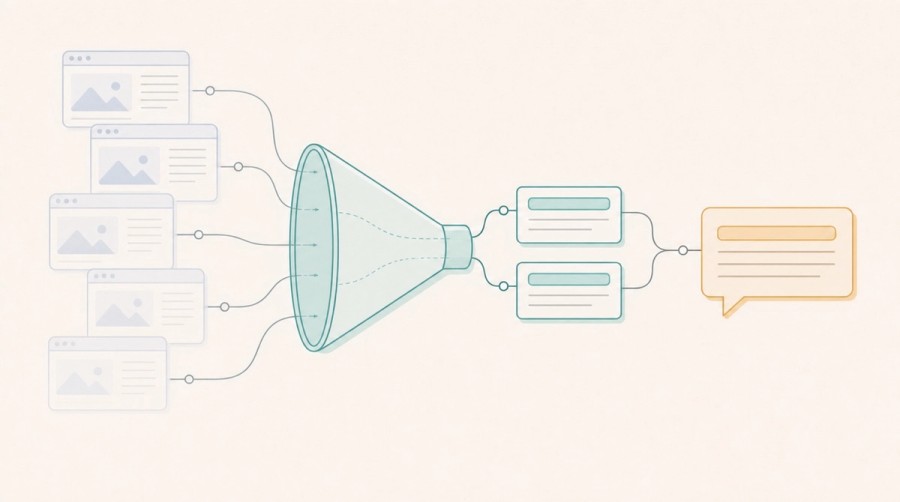
AI Overviews are not a separate ranking system running in parallel to Google Search — they're built on top of it. A page generally needs to be crawlable, indexed, and already ranking reasonably well for the query before it has any chance of being pulled into an Overview. Beyond that baseline, a few factors consistently correlate with which pages get pulled into the synthesis:
- A direct, self-contained answer appears early on the page, not after several paragraphs of preamble.
- Structured data (Article, FAQPage, HowTo) makes the page's content unambiguous to parse.
- Freshness matters more for time-sensitive queries, less for stable reference topics.
- The page belongs to a site with topical depth on the subject, rather than being an isolated one-off post with no supporting context.
Step-by-step: optimizing a page for AI Overviews
Step 1: Confirm the page is actually crawlable and indexed
None of the rest matters if Googlebot can't reach the page or it isn't indexed. Confirm it in Search Console before touching anything else — our AI visibility checklist covers the same fundamentals that apply across every AI answer engine, Google included.
Step 2: Don't skip organic ranking fundamentals
Because Overviews are built on top of the organic index, there's no shortcut around ranking reasonably well for the query in classic search first. Treat AI Overview optimization as an additional layer on solid SEO, not a replacement for it.
Step 3: Answer the target question in the first 2–3 sentences
State the direct answer in plain language immediately after the relevant heading, then use the following paragraphs to add nuance, caveats, and supporting detail. A synthesis model has an easier time lifting a clean, self-contained statement than extracting a conclusion buried at the end of a long narrative lead-in.
Step 4: Add structured data to make the answer machine-parseable
Article, FAQPage, and HowTo schema all give a synthesis model an unambiguous, pre-parsed version of your answer to draw from, instead of forcing it to infer structure from raw prose. Consistent entity markup also helps confirm who's speaking — see our guide on building entity authority for the underlying signals.
Step 5: Build topical depth around the query cluster
A single isolated page competes on its own. A page backed by several related pieces covering adjacent questions — the kind of subtopics that show up in "People also ask" boxes — signals real depth on the subject, which appears to correlate with being treated as a more reliable source to pull from.
Step 6: Track whether you're actually appearing
Standard rank trackers don't reliably capture Overview citations. Run incognito searches for your target queries on a regular cadence and log the results manually — tedious, but currently the most reliable method available.
Common mistakes that keep pages out of AI Overviews
- Confusing Google-Extended with Googlebot, and blocking the wrong one.
- Burying the direct answer after several paragraphs of scene-setting.
- Shipping pages with no structured data at all.
- Publishing an isolated page with no supporting topical cluster around it.
- Ignoring the adjacent questions a reader would naturally ask next.
How this differs from optimizing for ChatGPT and Perplexity
AI Overviews stay anchored to Google's existing organic index in a way ChatGPT Search and Perplexity aren't — both of the latter can pull from a broader, more live retrieval layer regardless of classic ranking position. See our comparisons of ChatGPT Search vs. Google Search, how Perplexity chooses its sources, and the broader 7 key differences between GEO and traditional SEO for the full picture across engines.
Putting it together

AI Overview optimization is additive, not a separate discipline: fix crawlability, keep investing in organic ranking, answer directly and early, mark up the page, and build the topical cluster around it. Run GeoReady's free AI Citation Checker before and after changes to confirm the technical basics hold, and see our complete guide to Generative Engine Optimization for how this fits into the bigger picture.
Further reading
Apply this guide
Run an AI SEO audit before you change pages.
Use the audit to find which signal is holding the site back: crawler access, schema, llms.txt, content clarity, AI discovery, or entity strength.
- Best for pages that need a technical and content baseline.
- Next metric: AI readiness score plus the weakest signal category.
Frequently asked questions
Does blocking Google-Extended keep my site out of AI Overviews?
No. Google-Extended controls whether your content can be used to train Gemini and future Google AI models — it has no confirmed effect on whether your pages are crawled, indexed, or eligible to appear in Search or AI Overviews. That's governed by standard Googlebot access and your normal search indexing status.
Do I need to rank #1 organically to be cited in an AI Overview?
No, but you generally need to be indexed and ranking reasonably well for the query. Overviews often cite several sources beyond the top organic position, since they're synthesizing an answer rather than picking a single winner.
Can I remove one page from AI Overviews without de-indexing it from Search entirely?
There's no confirmed, narrowly-scoped opt-out limited to AI Overviews alone. A noindex directive removes the page from Google Search entirely, including standard organic results — not just the Overview.
How do I know if I'm actually being cited in AI Overviews?
Standard rank trackers don't reliably capture Overview citations yet. The most reliable method is still running incognito searches for your target queries and checking manually, repeated on a regular cadence since Overviews change frequently.
Get the monthly State of GEO report
AI search readiness benchmarks, adoption stats, and the actions that move the needle — delivered monthly. No spam.
By submitting, you agree to receive the monthly GeoReady newsletter: benchmark data from the State of GEO dataset, practical GEO guidance, and product updates. You can unsubscribe anytime. See our Privacy Policy.