GEO for SaaS: How B2B Software Companies Get Cited by ChatGPT and Perplexity
B2B buyers increasingly ask ChatGPT and Perplexity 'what's the best tool for X' before ever visiting a vendor site. Here's how SaaS companies get included in that answer.
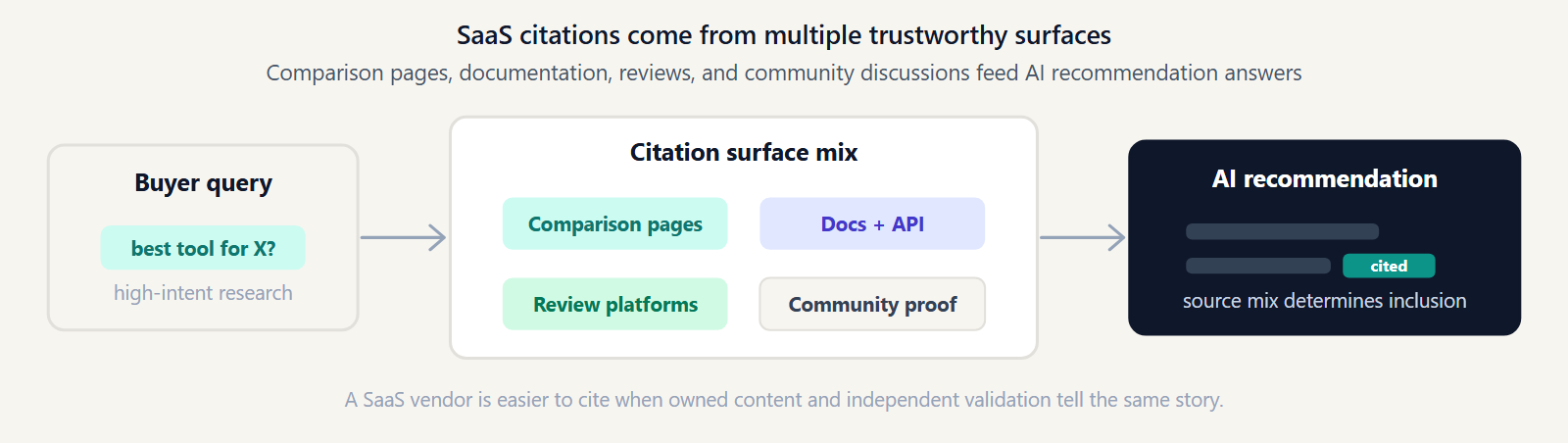
B2B software buyers increasingly ask ChatGPT or Perplexity "what's the best tool for X" before a vendor's website ever enters the picture. For SaaS companies, being included in that first AI-mediated research pass is starting to matter as much as ranking on Google once did — and it depends on a different set of assets than a typical content site.
Why GEO works differently for SaaS
Software buying decisions lean heavily on comparison and third-party validation — more than most consumer content categories. An AI answer to a software recommendation query typically synthesizes from comparison pages, product documentation, and independent review platforms, not just a vendor's own marketing copy. That changes where the GEO effort needs to go.
The SaaS-specific citation surfaces
- Comparison pages ("X vs Y") — among the highest-intent content type for software buying queries.
- Product documentation and API references — precise, technical, and easy for a model to trust and quote directly.
- Review platforms — G2, Capterra, TrustRadius — read as independent, cross-referenced validation.
- Community discussion — Reddit threads, Hacker News, developer forums — often surfaces in answers to "what do people actually think" style questions.
- "Best tools for X" roundup content — both third-party roundups and, done honestly, a vendor's own.
Building a GEO-ready SaaS content strategy
Step 1: Publish honest comparison pages
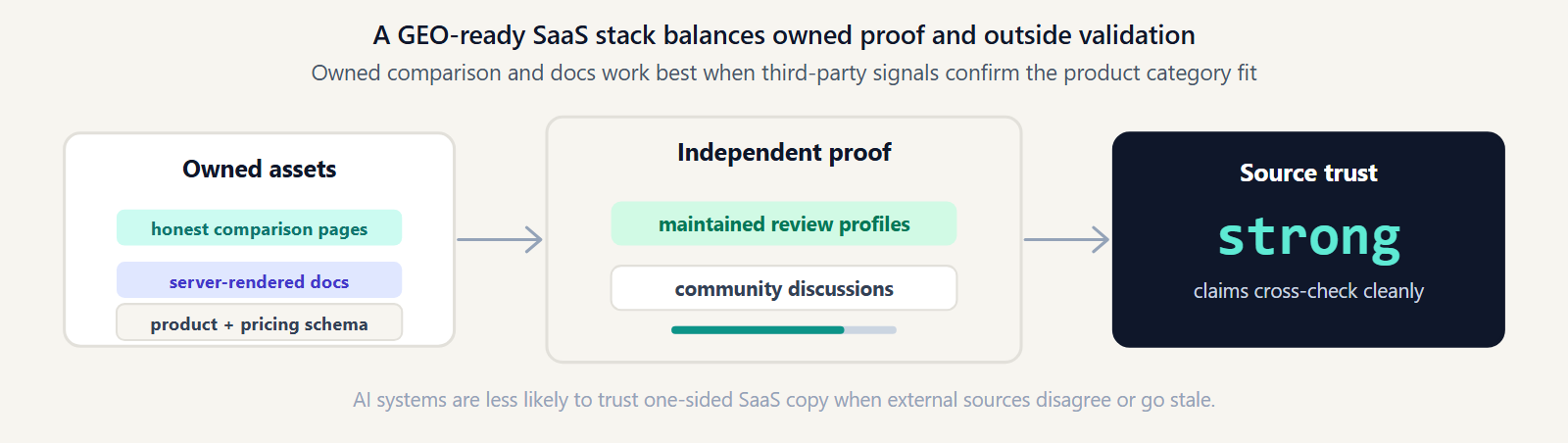
A comparison page that only flatters its own product reads as marketing, and AI systems synthesizing from multiple sources tend to discount one-sided framing when a competitor's own materials or independent reviews say otherwise. Acknowledging real competitor strengths, then making a clear, specific case for where you win, is both more credible and more quotable.
Step 2: Treat documentation as a citation asset, not just support content
Docs are often the most precise, unambiguous content a SaaS company owns. Making sure they're server-rendered, not gated behind login for public-facing sections, and organized with clear headings turns them into one of the strongest GEO assets available — more so than most marketing pages.
Step 3: Actively manage third-party review presence
A complete, actively-maintained G2 or Capterra profile, with responses to reviews (including critical ones), reads as a maintained, trustworthy presence rather than an abandoned listing.
Step 4: Participate genuinely in community spaces
Reddit threads and forum discussions about a product category get pulled into AI answers about "what people actually think." Genuine, disclosed participation (not disguised marketing) builds the kind of independent-sounding presence that's hard to manufacture after the fact.
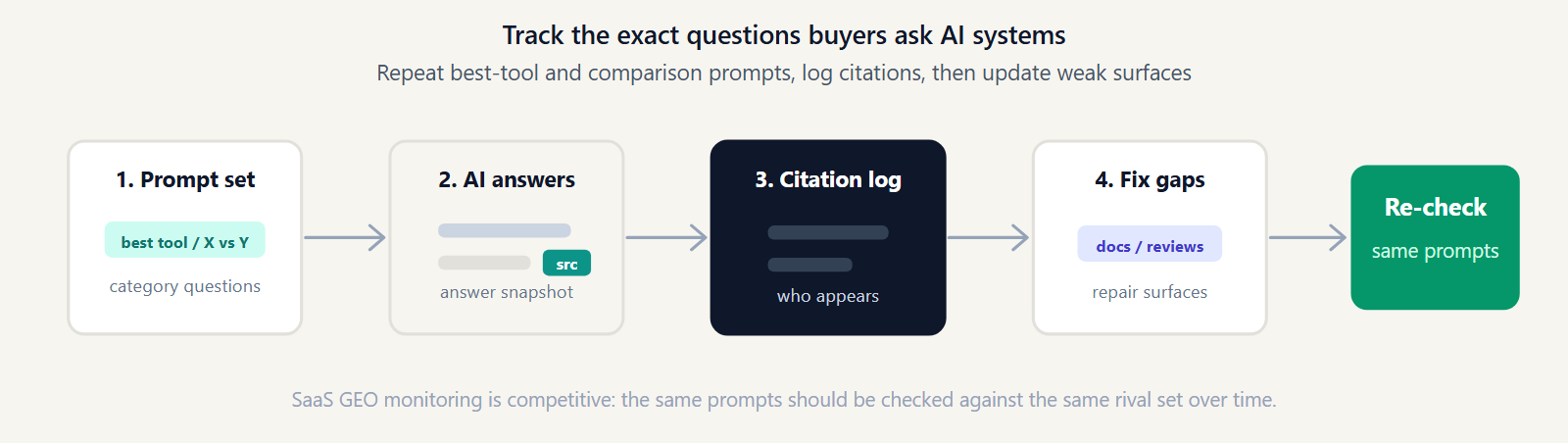
Step 5: Track whether you're cited in comparison-style answers
Ask ChatGPT and Perplexity your own category's "best tool for X" and "X vs Y" questions directly and repeatedly — the same manual-testing habit that applies across every GEO effort, just pointed at your specific competitive set.
Common mistakes
- One-sided comparison pages that omit real competitor strengths.
- Documentation locked behind login or rendered only client-side.
- An abandoned or incomplete G2/Capterra profile.
- No structured data on pricing or product pages.
How this fits the broader GEO picture
Everything here builds on the same fundamentals covered in our 7 key differences between GEO and traditional SEO and our guide to building entity authority — SaaS just concentrates the effort on comparison content, docs, and third-party validation specifically.
Further reading
Apply this guide
Turn SaaS GEO research into a prioritized audit.
Use the audit to see which product, comparison, documentation, and entity signals need work before AI engines can recommend the company.
- Best for best-tool, comparison, alternative, and category prompts.
- Next metric: mention share and citation share by buyer-intent prompt.
Frequently asked questions
Is GEO for SaaS different from GEO for a normal content site?
The fundamentals (crawlability, structured data, entity clarity) are the same. What differs is the citation surface: B2B software buyers rely heavily on comparison content, documentation, and third-party review platforms in a way that a typical content site doesn't need to think about as much.
Do review sites like G2 and Capterra matter more than a company's own website for AI citation?
They matter as independent, cross-referenced sources, which AI systems tend to weigh alongside a vendor's own claims rather than instead of them. Neglecting them while over-investing only in owned content leaves a gap.
Can a small SaaS company compete with a well-funded competitor on GEO?
Yes, more easily than on traditional SEO in some respects — clear, honest comparison content and well-structured documentation can earn citation regardless of marketing budget, since AI systems reward clarity and directness over domain authority alone.
Get the monthly State of GEO report
AI search readiness benchmarks, adoption stats, and the actions that move the needle — delivered monthly. No spam.
By submitting, you agree to receive the monthly GeoReady newsletter: benchmark data from the State of GEO dataset, practical GEO guidance, and product updates. You can unsubscribe anytime. See our Privacy Policy.