5 Signs Your Website Isn't Being Cited by AI (and How to Fix Each One)
Zero AI referrals, invisible in 'best X' answers, competitors cited instead. 5 signs your site is invisible to AI search — and the fix. Audit free.
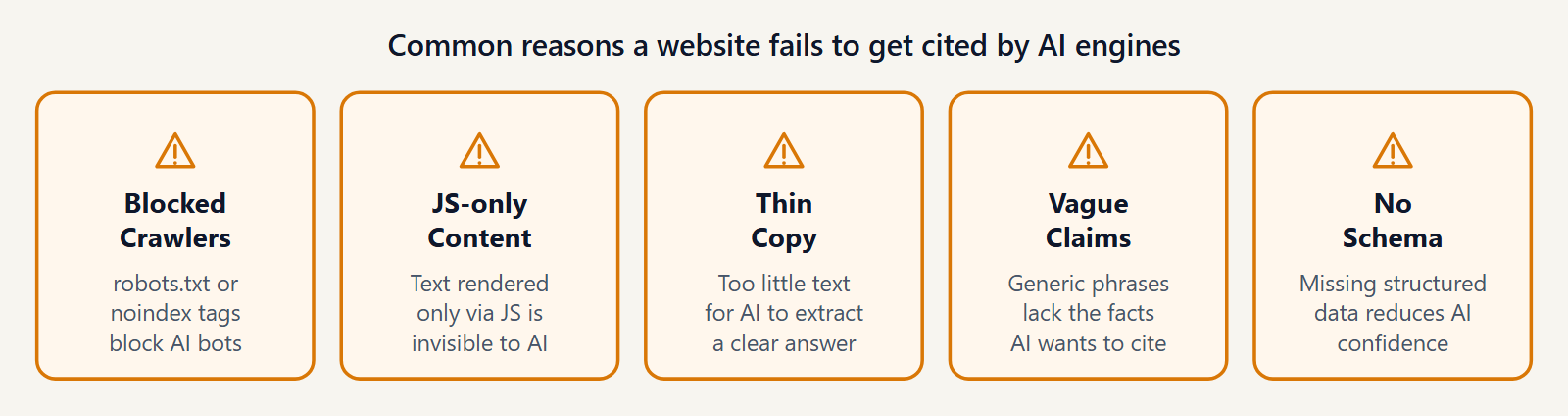
Most sites don't find out they're invisible to AI search until someone points it out. Here are five concrete, checkable signs — and exactly what to do about each one.
1. Zero AI referral traffic in analytics
Check your traffic sources for chatgpt.com, perplexity.ai, gemini.google.com, and claude.ai. If none of these have ever sent a visit, that's your first data point. Fix: confirm the site is even crawlable (see sign 4) before assuming a content problem.
2. You've never seen your brand name in an AI answer
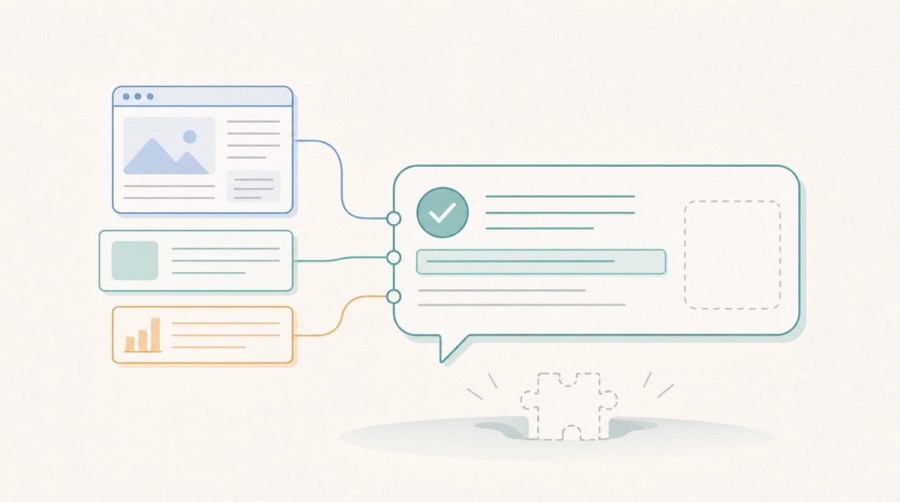
Ask ChatGPT and Perplexity directly about your product category and see if you come up. Do this monthly, not once — answers shift as models and their retrieval indexes update. Our AI visibility checklist walks through a repeatable version of this test.
3. Competitors get cited in "best X" answers and you don't
If a direct competitor consistently shows up in "best tools for X" or "top providers in Y" answers and you never do, it usually points to weaker entity signals — less consistent naming, fewer authoritative mentions, or thinner comparison content — not a technical block.
4. Your robots.txt or CDN blocks AI bots
This is the most common purely technical cause. Check your robots.txt against the full list of AI crawlers, or just run it through GeoReady's free AI Citation Checker to confirm in seconds.
5. No structured data, thin entity signals
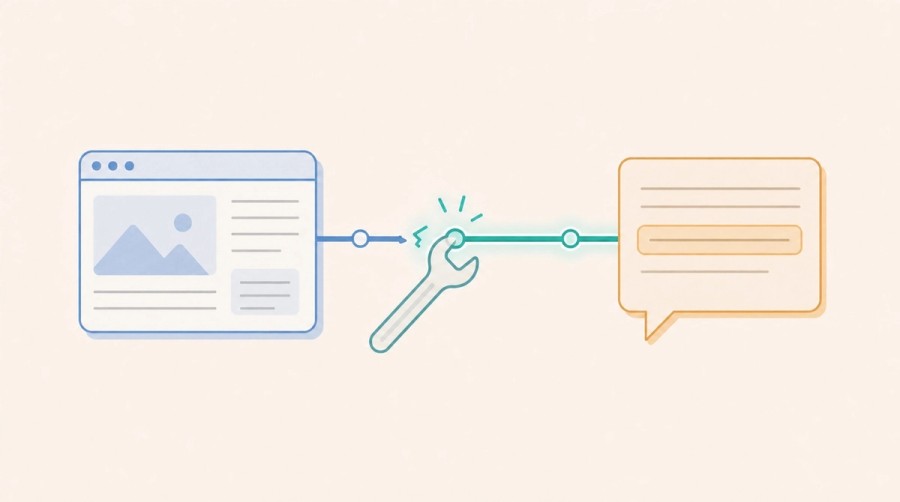
If your pages have no Organization, Article, or FAQPage schema, and your brand name is inconsistent across your own site, AI systems have a harder time confirming who you are and what you offer. See our guide on building entity authority for the fix.
Further reading
Apply this guide
Run an AI SEO audit before you change pages.
Use the audit to find which signal is holding the site back: crawler access, schema, llms.txt, content clarity, AI discovery, or entity strength.
- Best for pages that need a technical and content baseline.
- Next metric: AI readiness score plus the weakest signal category.
Frequently asked questions
How do I see AI referral traffic in my analytics?
Look for referrer domains like chatgpt.com, perplexity.ai, gemini.google.com, and claude.ai in your analytics tool's traffic-source report. Most platforms group these under 'AI' or 'Other' by default — you may need a custom segment.
Is zero AI referral traffic always a bad sign?
Not necessarily for brand-new sites or very niche B2B topics with low query volume. It's a stronger signal when combined with the other four signs — blocked crawlers, no structured data, or direct competitors being cited instead.
Can I fix all five signs myself without a developer?
Most of them, yes — robots.txt edits, llms.txt creation, and basic schema markup are text-file changes. Rendering issues (content requiring JavaScript) sometimes need developer involvement.
Get the monthly State of GEO report
AI search readiness benchmarks, adoption stats, and the actions that move the needle — delivered monthly. No spam.
By submitting, you agree to receive the monthly GeoReady newsletter: benchmark data from the State of GEO dataset, practical GEO guidance, and product updates. You can unsubscribe anytime. See our Privacy Policy.