Structured Data for AI Citations: The Complete Schema Markup Guide
Schema guides AI engines to parse your page unambiguously and cite it correctly. Complete implementation guide from rich results to AI. Audit free.
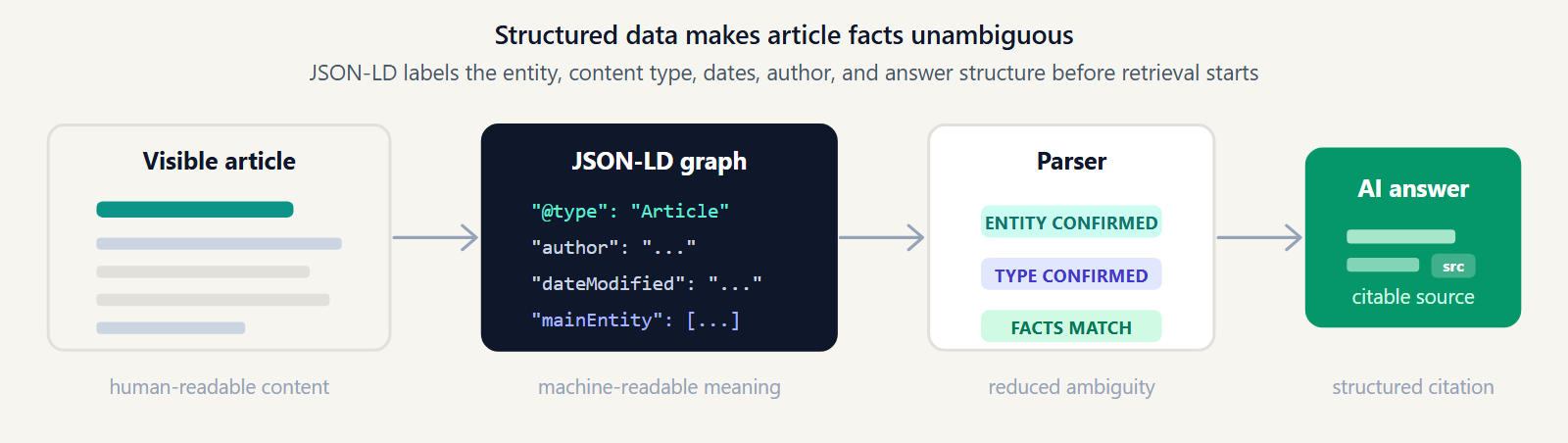
Schema markup used to be a rich-results play: add the right JSON-LD and maybe earn a star rating or a recipe card in Google. That's still true, but it's no longer the main reason to bother. AI answer engines lean on structured data to resolve exactly what a page is, what it's saying, and who's saying it — without needing to infer any of it from loosely-structured prose.
Why structured data matters more, not less, in the AI search era
A language model summarizing or citing a page still has to figure out, from raw content, what type of thing it's looking at, what the direct answer is, and which entity is responsible for it. Structured data answers all three questions explicitly instead of leaving them to inference — which matters most exactly when a system is operating at the speed and scale required to answer a live query.
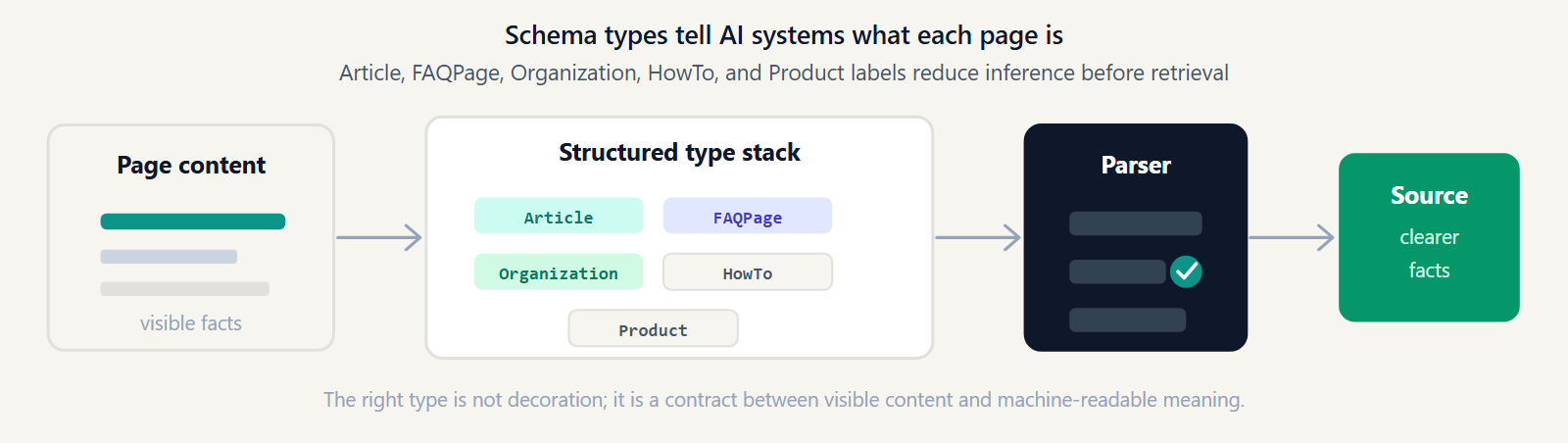
The schema types that matter most for AI citation
Article / TechArticle / BlogPosting
The baseline: confirms a page is an article, states its headline, author, and publish/modified dates. Simple, but it's the foundation everything else builds on.
FAQPage
Direct question-and-answer pairs, structured explicitly. This is close to an ideal format for citation: short, self-contained, unambiguous statements that a synthesis model can lift almost verbatim.
Organization and sameAs
Declares who's actually behind the content and links that identity to your presence elsewhere (social profiles, Wikipedia/Wikidata, review platforms) via the sameAs array. See our guide on building entity authority for the broader signals this feeds into.
HowTo
Marks up sequential steps explicitly, which helps for any query phrased as "how do I..." — exactly the kind of question an AI answer engine is built to resolve directly.
Product
Declares price, availability, and ratings in a structured, unambiguous format — increasingly important as AI shopping assistants make recommendations directly from structured product data rather than parsing marketing copy.
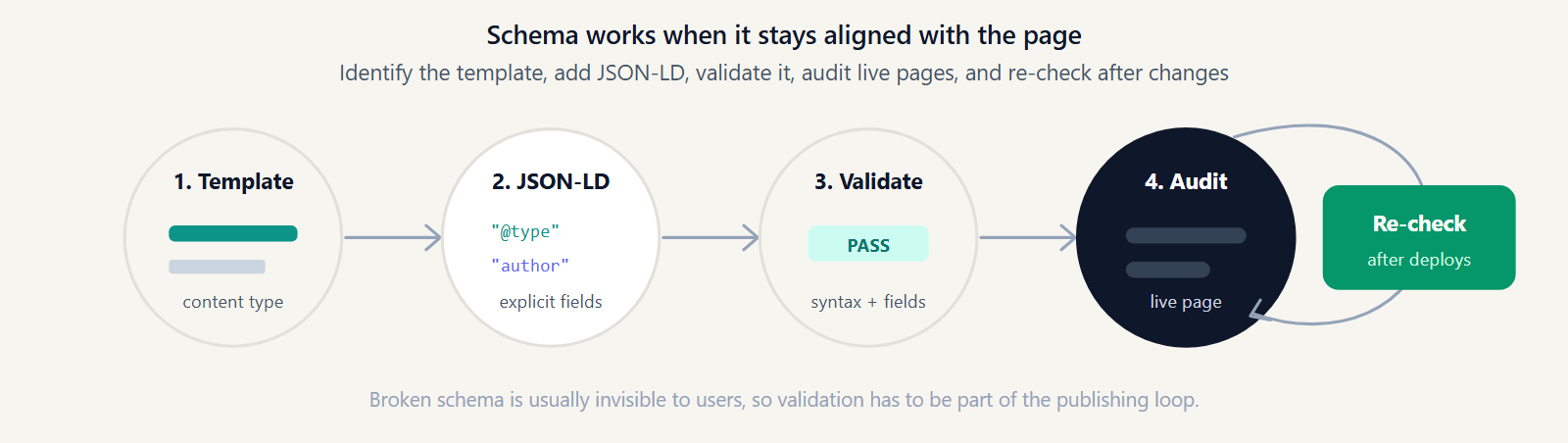
A step-by-step way to implement it without breaking anything
Step 1: Identify the content type on each page template
Match each template to the schema type that actually describes it — don't mark a blog post as a Product, and don't force HowTo structure onto content that isn't genuinely sequential.
Step 2: Implement as JSON-LD
Add it as a self-contained script block rather than annotating your visible HTML — it's easier to maintain and far less likely to break your page layout during a redesign.
Step 3: Validate before deploying
Malformed JSON-LD is often silently ignored rather than throwing a visible error, which means broken schema can sit undetected for months. Validate every template before it ships, not after someone notices lost rich results.
Step 4: Audit what's already live
Existing pages accumulate schema drift — fields that no longer match the visible content, or markup left over from a previous template. Run an audit and compare what's declared against what's actually on the page; GeoReady's AI Citation Checker covers this alongside crawlability checks.
Step 5: Re-check after every template change
Schema markup isn't a one-time task. Redesigns and CMS migrations are the single most common cause of previously-valid schema quietly breaking.
Common mistakes worth avoiding from day one
- Schema that describes content the page doesn't actually contain — a mismatch signal, not a shortcut.
- Missing required fields for the type you've declared (a Product with no price, an Article with no author).
- Duplicate, conflicting schema blocks left behind from an old plugin or template.
- Forgetting to update schema when the visible content changes, so the two quietly drift apart.
Putting it together
Structured data is one layer of a broader GEO effort — it doesn't replace crawlability, direct answers, or entity authority, it makes all three easier for a machine to confirm. See our complete guide to Generative Engine Optimization for how it fits into the bigger picture.
Further reading
Apply this guide
Check whether Perplexity-style answers cite your domain.
Use the citation checker path when the risk is that answer engines quote competitors, review sites, or third-party sources instead of your own pages.
- Best for source-backed answers where the cited URL matters.
- Next metric: direct citations, competitor citations, and missing citations.
Frequently asked questions
Does adding schema markup guarantee my page gets cited by AI?
No. Schema markup makes a page easier to parse unambiguously, which helps, but it doesn't override fundamentals like crawlability, relevance, and content quality. Treat it as a multiplier on good content, not a substitute for it.
Should I use JSON-LD, Microdata, or RDFa?
JSON-LD is the practical default for nearly every modern site — it's a separate script block that doesn't require touching your visible HTML structure, and it's what Google and most tooling primarily documents and tests against today.
Is it a problem that schema markup is invisible to visitors?
No — that's how it's designed to work. JSON-LD schema is a transparent, standardized way to describe a page to machines, declared openly in the page source rather than hidden through CSS tricks or obfuscation. That's a fundamentally different thing from disguising manipulative instructions, which relies on concealment rather than open declaration.
How often should schema markup be re-validated?
After any template change, CMS migration, or redesign — these are the most common causes of previously-valid schema silently breaking.
Get the monthly State of GEO report
AI search readiness benchmarks, adoption stats, and the actions that move the needle — delivered monthly. No spam.
By submitting, you agree to receive the monthly GeoReady newsletter: benchmark data from the State of GEO dataset, practical GEO guidance, and product updates. You can unsubscribe anytime. See our Privacy Policy.